
The outside of the house sets the mood before anyone steps through the front door. A few well placed lights and a little greenery can make the whole property feel festive after dark, and most of it comes together in an afternoon. The trick is restraint with a plan: one color palette, one clear focal point, and the same materials repeated from the street to the door. Pick a palette, repeat it, and let one piece do the heavy lifting.
This is an outdoor-only guide. It covers the yard, the porch, the roofline, and the front walk, not the living room or the tree inside. If you want indoor ideas, the mantel and the tree have their own guides.
Key Takeaways
- Start with the door, then add pieces on either side to frame it. Symmetry suits a formal entrance; one strong focal point suits a small one.
- Warm white lights read cozy after dark. Cool white reads cold and makes greenery look gray.
- A 30 inch wreath suits a standard front door. A 9 foot pre-lit garland frames the door without overwhelming it.
- Use only lights and cords rated for outdoor use, plug everything into a GFCI outlet, and keep plug connections off the ground.
- A 15 amp household circuit handles about 1,440 watts, and you should load it to only about 80 percent, roughly 1,150 watts.
- Most people decorate outside in early to mid November while the weather is mild, then switch the lights on after Thanksgiving.
Plan Before You Buy
Walk to the curb and look at the house the way a neighbor sees it. Note the roofline, the door, the walkway, and the biggest tree or shrub. Those are the four anchors of any outdoor display. Everything else is a supporting piece.
Choose one light color and one accent color, then repeat both from the street to the door. Warm white lights with red bows, or warm white lights with gold ornaments, are the two combinations that rarely fail. Mixing warm white, cool white, and multicolor in one display is the fastest way to make a yard look busy.
Measure before you shop. A roofline needs a known length. A door frame needs a known height. A tree needs a known height so you can buy enough lights: about 100 mini lights per foot of tree height is the usual starting point. A 6 foot yard tree needs about 600 lights. Buying first and measuring later is how garlands end up three feet short.
15 Outdoor Christmas Decoration Ideas
1. Outline the Roofline in Warm White Lights

A single clean line of warm white lights along the roofline frames the house and makes every other decoration read better after dark. Keep the line unbroken, follow the peaks and eaves evenly, and use one color of light so the outline looks calm rather than busy. Use plastic light clips instead of nails or screws, since nails damage shingles and gutters and leave holes that leak. Measure the roofline first and buy the length you need, plus one extra strand for the peaks.
2. Hang an Oversized Wreath on the Front Door

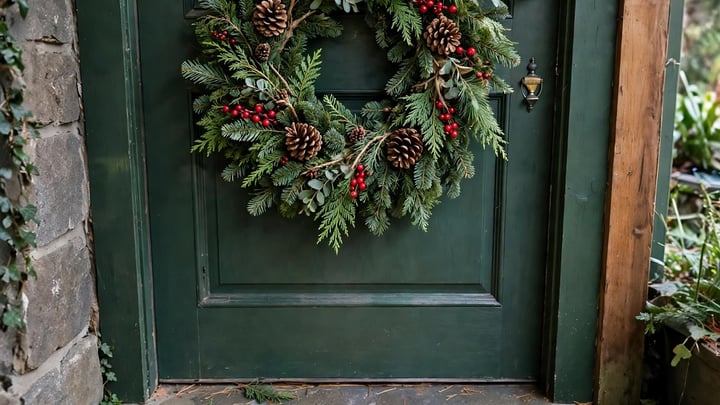
The front door does the heaviest lift of any outdoor decoration. Anyone driving by sees it before the yard, and it is the piece most often photographed after a holiday party. Go one size bigger than feels right: a 30 inch fresh cedar wreath on a standard door looks intentional in a way a 20 inch wreath never does. Fresh wreaths need a shady, cold porch to last past New Year. Full afternoon sun will dry one out by the third week. A pre-lit faux wreath is the better choice for a sunny door.
3. Frame the Door with a Pre-Lit Garland
A 9 foot pre-lit garland framing the door does more work than a wreath twice its price. Run it up one side of the door frame, across the top, and down the other side, then add a simple bow where the garland meets the top corners. The same garland can run along the porch railing if you have length left over, which ties the door to the rest of the porch. Choose a full garland that holds its shape outdoors, and weave the lights through it as you hang it rather than after.
4. Dress the Porch Columns in Lit Garland
Garland wrapped around porch columns connects the roof, the railing, and the doorway into one finished look. Wind it evenly from top to bottom and weave a strand of warm lights through it as you go. Add a simple bow where the garland meets the top of each column. Two columns wrapped the same way give the porch symmetry, and the vertical lines of the columns make the whole entrance feel taller.
5. Fill Tall Planters with Evergreens and Birch Logs

Two tall planters by the front door give height, color, and texture without a ladder. Fill each planter with evergreen branches, a few tall birch logs, pinecones, and a scattering of berries or gold ornaments. The planters work on a porch of any size, and they look good from the street because the height reads even at a distance. Once you own the planters, the filling costs almost nothing, since most of it comes from the yard or a single bag of cut greenery.
6. Line the Steps with Lanterns
Three or five black metal lanterns of graduated heights up one side of the porch steps, each with a fat battery pillar candle inside, turn a plain staircase into a welcome. Odd numbers look better than even ones, and the graduated heights keep the eye moving up the steps. Battery candles are the right choice here: real flames on steps are a risk with children, pets, and winter coats brushing past. Set the lanterns on the side away from the handrail so nobody has to step around them.
7. Light the Walkway with Luminarias

Luminarias, also called farolitos, are paper or plastic bags weighted with sand and lit from within, and they turn an ordinary path into a warm welcome. Set them in a straight row on either side of the walkway, spaced evenly, and use battery lights or LED candles inside for a safe, steady glow. They work on porches, steps, and driveways too. Paper bags need a dry forecast, so use plastic luminaria bags if rain is likely. Either way, the sand keeps them from blowing away.
8. Wrap One Tall Yard Tree in Lights

If the yard has a tall tree, wrapping it in lights gives a focal point that can be seen from down the street. Start at the trunk and work outward along the main branches, spacing the lights evenly. About 100 mini lights per foot of tree height is the usual starting point, so a 10 foot tree needs about 1,000 lights. Warm white reads best on bare winter branches. A single wrapped tree beats five half-lit shrubs, since one bright focal point organizes the whole yard.
9. Put a Lighted Reindeer on the Lawn
Nothing says Christmas on the lawn like a glowing reindeer. One or two lighted figures near the steps, on the lawn, or beside the front door give the yard an instant focal point, and children love them. Place the figure where it reads from the street, not tucked against the house. A reindeer, a Santa, or a sleigh works the same way: one figure, placed with space around it, reads as a centerpiece. Three figures crowded together read as a storage pile.
10. Add One Inflatable Display for the Kids
Inflatable Santas, snowmen, and reindeer are the most cheerful yard decorations for homes with children visiting, and they take minutes to set up. Choose one or two, anchor them with the stakes and tethers that come in the box, and give each one clear space so it reads from the street. An inflatable that is not anchored will end up in the neighbor’s yard on the first windy night. Keep the display to one theme and one corner of the lawn, so the yard still looks planned rather than filled.
11. Repeat Small Wreaths on the Windows
One generous wreath on the front door is the classic starting point, and repeating smaller wreaths on the front windows ties the whole facade together. Use the same greenery and the same bow on every window so the repetition reads as a design choice. Hang each wreath at the same height, centered on its window. A wreath on every window of a small house can be too much, so on a narrow facade, dress the two windows flanking the door and leave the rest bare.
12. Use Projector Lights for a Five Minute Display
If you want maximum impact for minimum effort, projector lights are the answer. Stake the projector in the yard, aim it at the house, and it casts moving snowflakes, stars, or festive patterns across the whole facade. In about five minutes the house transforms. Projectors suit renters and anyone who cannot climb a ladder, and they pair well with a wreath and a lit garland, since the moving light fills the wall between them. Aim the projector so the pattern lands on the house, not on the neighbor’s windows.
13. Mark the Path with Candy Cane Stakes
Candy cane stakes bring instant cheer to a walkway, especially for homes with children visiting. Alternate red and white striped stakes on both sides of the path, keep the spacing even, and choose solar or lighted versions so the path glows after dark. They are the simplest path marker in this list, and they work best in a straight row rather than scattered. Pull them up before the first snowplow passes, since a plow will take them with it.
14. Dress the Mailbox and Lamp Post
The mailbox and the lamp post are the two decorations the street sees first, and they cost the least. Wrap the lamp post in garland and finish it with a big bow. Add a small swag of greenery and a red bow to the mailbox, and tie the bow in the same style as the ones on the door and windows. A mailbox swag that matches the door garland makes the whole property look like one plan. Keep the swag clear of the mailbox door and the flag so the mail still works.
15. Set Lit Cone Trees on the Porch or Lawn
Cone-shaped pre-lit trees bring structure to a yard or porch without the work of wrapping a real tree. Place a pair flanking the front door, or a trio of different heights on the lawn, and let them anchor the display. They read best in odd numbers and at different heights, and they suit a modern house where a traditional wreath would look out of place. Battery or solar versions work where no outlet is close, and they store flat in January.
Power and Safety: The Part That Matters Most
Outdoor Christmas lights are an electrical installation that lives in rain and snow for a month, so the safety rules are not optional.
Use only lights and extension cords specifically rated for outdoor use. Outdoor cords are round, with a UL tag that says suitable for outdoor use, and they stay flexible in cold weather and stand up to UV radiation and water. Thin flat indoor cords do not. Look for a UL or ETL mark on both the lights and the cords.
Plug everything outdoors into a GFCI outlet. A ground fault circuit interrupter shuts off power when it detects an imbalance in the current, which protects against shock in wet conditions. Press the TEST button on each outdoor GFCI before decorating, then RESET. If it will not trip or will not reset, have it replaced. If the house has no outdoor GFCI outlets, use a portable GFCI adapter.
Mind the load. A standard 15 amp household circuit handles about 1,440 watts, and you should load it to only about 80 percent, roughly 1,150 watts. Add up the wattage of everything on one circuit before you plug it in. LED holiday lights use a fraction of the power of incandescent strands, run cooler, and let you connect more strands safely, which is one more reason to choose LED for the roofline and the tree.
Follow the manufacturer’s limit on how many strands can be connected end to end. Older incandescent strands allow far fewer than LED sets. Do not daisy-chain extension cords or plug power strips into power strips, since each connection concentrates heat.
Use plastic light clips instead of nails, staples, or screws to secure lights. Nails and staples damage insulation and create hot spots. Elevate plug connections off the ground with stakes or hangers, use weatherproof covers on outlet connections, and point plug connections downward so water runs off. Never run cords through puddles, under rugs, or across walkways where they become a trip hazard. Take the lights down within two to three weeks after the holiday season, since a display left up all winter weathers the cords and the connections.
When to Put It Up and Take It Down
Most people decorate outside in early to mid November while the weather is still mild, then turn the lights on after Thanksgiving. That schedule has a practical reason: hanging roofline lights in a coat and gloves is miserable, and cold fingers drop clips. Put the greenery and the figures up while it is still comfortable, test every strand on the ground first, and save the switch-on for the holiday itself.
Take the display down within two to three weeks after Christmas. Lights left up through winter fade, crack, and tangle, and a yard that still glows in February reads as forgotten rather than festive. Store the strands coiled loosely in a dry bin, not wound tight around an elbow, so they last for next year.
Common Mistakes to Avoid
The most common outdoor mistake is too many colors. Warm white, cool white, multicolor, and red all in one yard fight each other, and the house disappears behind the noise. Pick one light color and repeat it.
The second mistake is no focal point. A yard with a little of everything and no single bright piece looks scattered. One wrapped tree, one roofline, or one glowing figure organizes the rest.
The third mistake is indoor cords outside. An indoor extension cord in rain or snow is a genuine hazard, and it is also the mistake most often made. Check every cord for an outdoor rating before it leaves the house.
The fourth is blocking the walkway. Luminarias, lanterns, and stakes belong beside the path, not on it. A guest carrying a dish should not have to step around a decoration. The fifth is skipping the GFCI test. A GFCI that has not been tested in a year may not trip when it needs to, and the test takes ten seconds.
FAQ
When should I put up outdoor Christmas decorations?
Most people decorate in early to mid November while the weather is mild, then turn the lights on after Thanksgiving.
How many lights do I need for an outdoor tree?
About 100 mini lights per foot of tree height. A 10 foot tree needs about 1,000 lights.
Are outdoor Christmas lights safe in rain and snow?
Yes, when they are rated for outdoor use and plugged into a GFCI outlet with weatherproof covers. Indoor-rated lights and cords should never go outside.
Conclusion
An outdoor Christmas display does not need to be the biggest on the block. It needs one palette, one focal point, and lights that are installed safely. Start with the door, add the roofline or a wrapped tree, repeat the same materials to the walkway, and stop before the yard gets crowded. The neighbors notice a display that looks planned far more than one that looks expensive.



Leave a Reply
You must be logged in to post a comment.