
Minimalist Christmas decor is not an empty room with a tree in the corner. It is a holiday look built on fewer pieces, a limited palette, and natural texture, so each choice reads as deliberate. When it works, the house feels calm and warm at the same time, not bare and not busy.
This guide covers the decisions that make that balance possible: palette, tree shape, ornament count, mantel and table styling, lighting, and the mistakes that turn restraint into a room that looks unfinished.
Key Takeaways
- Pick one focal point per room and let the rest of the room stay quiet.
- Limit the palette to two colors plus greenery, then repeat those colors in every decorated spot.
- Choose a slim or pencil tree when you plan to use fewer ornaments, so the shape does more of the work.
- Use warm light and varied texture to keep neutral colors from feeling cold.
- Leave empty space on purpose. The gaps are part of the look, not a sign that something is missing.
What Minimalist Christmas Decor Actually Means
Minimalist Christmas decor means editing before you decorate. Instead of adding a new item to every surface, you choose a small set of pieces that work together and give each one room to be seen.
The style suits modern homes because it respects the room that is already there. Clean lines, plain walls, and simple furniture stay visible. Holiday pieces sit within that setting rather than covering it.
It does not mean removing color or warmth. A minimalist room can still have a full tree, candles, greenery, and a dressed table. The difference is that nothing is there only to fill space. If a piece does not fit the palette, the material set, or the focal point of its room, it stays in storage.
A useful test before you hang or place anything is to ask whether removing it would make the room feel emptier or calmer. If the answer is calmer, the piece is probably adding noise rather than meaning.
Start With Three Decisions, Not a Shopping List
Most minimalist rooms that look unfinished fail at the planning stage, not at the buying stage. Three decisions, made before any decorating starts, keep the whole house consistent.
First, choose one focal point per room. In the living room, that is usually the tree. On a mantel wall, it is the mantel. At dinner, it is the table. One focal point gives the eye a place to land. Two competing focal points in the same sightline make even a small number of pieces feel crowded.
Second, choose two colors plus greenery. Greenery counts as a free color because it appears in the tree, the wreath, and the garland anyway. Two colors are enough to repeat across rooms and create a sense of planning. Three or four accent colors start to pull the look back toward a traditional, fuller display.
Third, choose three kinds of texture to repeat. A soft texture, such as wool or knit, a natural texture, such as wood or linen, and a smooth sheen, such as brass, ceramic, or clear glass, give a neutral room depth without adding more objects. When a room looks flat, the usual cause is a missing texture, not a missing decoration.
Write these three decisions down before you open a storage box. They make the rest of the choices faster, and they stop the common pattern of buying one more item because a shelf looks bare.
Choose a Palette That Stays Calm
A limited palette is the fastest way to make a small number of pieces look intentional. Pick one of the combinations below and use it on the tree, the mantel, and the table, with greenery as the shared third element.
| Palette | Colors | Best for |
|---|---|---|
| White and wood | White, cream, natural wood | Bright rooms, Scandinavian style, small spaces |
| Cream and brass | Cream, ivory, brushed brass | Warm living rooms, classic furniture, evening light |
| Sage and cream | Sage green, cream, soft gold | Rooms with plants, muted walls, natural materials |
White and wood is the easiest starting point. It works with light floors and pale walls, and wood keeps white from feeling stark. Cream and brass suits rooms that already have warm metals in lamps, frames, or hardware. Sage and cream adds a little color while staying close to the greenery already in the room.
Avoid adding a bright red or a strong jewel tone as a third accent unless you plan to repeat it in at least three places. A single red bow on a wreath, with no red anywhere else, reads as an accident rather than a choice. If you love red, use a muted version, such as a deep cranberry in ribbon or a single row of dried orange slices, and repeat it sparingly.
Decorate the Tree With Less, on Purpose

The tree is where minimalist decorating succeeds or fails, because it is the largest single object in the room. A slim or pencil tree suits this look better than a wide, full tree. A narrow shape looks complete with fewer ornaments, while a wide tree with the same small number can look unfinished, as if the decorating stopped halfway.
Size matters in a practical way too. A 6-foot tree fits most living rooms with standard 8-foot ceilings and leaves room for a topper without crowding the ceiling. A 7-foot tree needs a higher ceiling and a wider base area, and it asks for more ornaments to fill its larger silhouette. In a small apartment, a 4-foot or 5-foot tree on a sturdy side table, or a slim pencil tree in a corner, can feel more festive than a full-size tree squeezed against a sofa.
For ornament count, use a simple starting point rather than a fixed rule. Many decorating guides suggest about 10 ornaments per foot of tree height for a pared-back tree, roughly half the count of a fuller tree. On a 6-foot tree, that means about 60 ornaments as a starting point, spaced so branches stay visible between them. On a small 4-foot tree, the same starting point gives about 40. Treat these numbers as a guide to begin with, then step back and adjust. If the tree still looks busy, remove pieces. If it looks bare, add texture first, such as ribbon or lights, before adding more ornaments.
Limit ornament materials to two or three at most. All wood, all ceramic, or a mix of clear glass and one metal reads as calm and deliberate. A mix of wood, glass, ceramic, fabric, and metal in one tree starts to look busy even when the colors match.
Hang ornaments at different depths, not only on the outer tips of branches. A few pieces tucked closer to the trunk add depth and make the tree look layered rather than flat. Keep the largest ornaments lower, where the branches are stronger, and the smallest near the top.
Skip tinsel and heavy garland. A single thin ribbon in a loose drape, or one strand of wooden beads, is enough if you want a garland at all. Picks and sprays can stay in storage. For the topper, a simple star, a loop of linen ribbon, or a small cluster of branches keeps the vertical line clean. A large, glittered topper fights with the restraint of the rest of the tree.
For the base, a plain linen tree skirt in cream or oatmeal, or a woven collar in natural fiber, suits the look better than a bright or patterned skirt. The base should anchor the tree without becoming a second focal point.
Style the Mantel in One Line

A mantel works best as a single horizontal line with one break in it. Lay a short run of fresh greenery, such as cedar or eucalyptus, flat along the shelf. Add a cluster of pillar candles in three heights about a third of the way along, and stop there. The empty space between the greenery and the candles is doing as much work as the pieces themselves.
If you want one vertical element, lean a plain frame or a mirror against the wall above the mantel, or stand a single tall branch in a vase at one end. One vertical is enough. Two or three tall objects at different points along the shelf split the line and make the mantel feel cluttered.
Stockings, when you use them, should follow the same palette as the rest of the room. Plain linen, wool, or cotton in cream, beige, gray, or muted green keeps the mantel quiet. Patterned or brightly colored stockings pull attention away from the greenery and candles. Hang them with space between each one rather than crowding them side by side.
If you have no mantel, the same idea works on a console table, a sideboard, or a windowsill. One low line of greenery, one candle cluster, and empty space around them is enough to mark the season in that spot.
Set a Table That Feels Dressed, Not Crowded

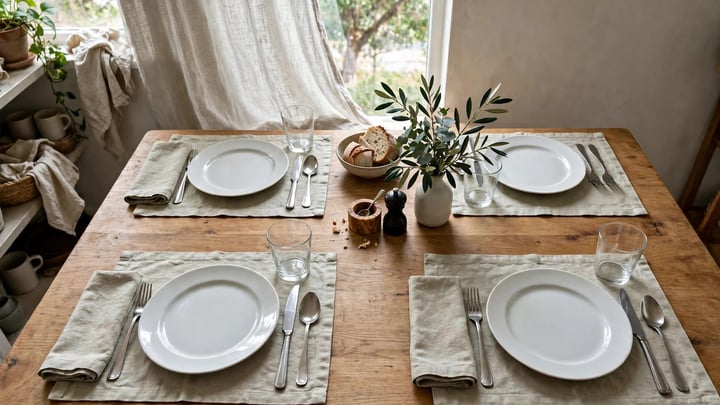
A minimalist holiday table relies on linen, ceramic, and greenery rather than on a tall centerpiece. Leave a wood tabletop partly visible and run one long linen runner down the center instead of covering the whole table with a cloth. The wood grain adds warmth, and the runner gives the place settings a shared line to sit on.
Down the center, use a low line of small bud vases, a flat run of greenery, or a row of plain taper candles in simple holders. Keep the centerpiece low enough that people can see each other across the table. A tall arrangement forces guests to lean around it and turns the table into a display rather than a place to eat.
At each place, one small detail is enough. A sprig of rosemary or pine tied with twine on a napkin, or a single pinecone beside the plate, marks the seat without adding another object to clear away. Plain ceramic plates and simple glassware suit the look. Patterned chargers, colored glasses, and a second layer of decoration at each seat add visual noise in a spot where people need elbow room.
For the chairs, skip chair covers and large bows. A folded throw over the back of one chair, or a plain cushion in the room palette, is enough if the dining area needs softening.
Carry the Look Beyond the Living Room

Not every room needs decorating, and leaving a room alone is part of the minimalist approach. Choose the rooms people actually use in the evening, usually the living room, the dining area, and the entry, and give each one a single focal point.
In the entry, one wreath on the door and one small arrangement on a console table is enough. A simple wreath of fresh greenery, olive branches, or eucalyptus, with a single ribbon if you want one, reads as modern. A wreath crowded with ornaments, berries, and bows belongs to a fuller style.
In the bedroom, swap a throw or a cushion cover for one in the room palette and add a small vase of greenery on a nightstand. Holiday bedding with a busy print fights with the calm of a bedroom, so keep the change to texture and color rather than pattern.
In the kitchen, give the season one surface. A plain bowl of pinecones, a small vase of cedar on the island, or a linen tea towel in the palette marks the room without turning the counters into a display. Clear the other counters first. Greenery on a crowded counter looks like clutter. Greenery on a clear counter looks like a choice.
In a bathroom or a hallway, a single small branch in a vase or one candle on a shelf is enough. These rooms work best with a hint of the season rather than a full arrangement.
Light Is What Keeps Minimalism Warm

The most common complaint about minimalist Christmas decor is that it feels cold. The usual cause is not a lack of objects. It is a lack of warm light and soft texture.
Use warm white lights only, not cool white and not multicolor, on the tree, the mantel, and the wreath. Warm white light softens neutral colors and makes wood, linen, and brass look richer. Cool white light makes the same palette look stark, and multicolor lights break the limited palette in every spot they appear.
Keep the full light count on the tree even when you cut the ornament count. Lights are what make a sparsely decorated tree feel warm in the evening. A tree with few ornaments and few lights looks unfinished. A tree with few ornaments and a full run of warm lights looks intentional.
Candles add a second layer of warmth. White or cream pillar candles in plain holders, grouped in threes on a tray, give a mantel or a table a glow that string lights cannot match. Use battery candles with a warm tone if open flames are not practical in your home, especially near greenery or in a room with children or pets.
In the evening, turn off the overhead light and let the tree lights and candles carry the room. Overhead light flattens a neutral palette. Low, warm light gives the same room depth.
Small Spaces and Apartments
Minimalist Christmas decor suits small homes because it asks for less floor space and less storage. A slim tree in a corner, a wall-mounted branch tree, or a tabletop tree can mark the season without blocking a walkway.
If floor space is tight, a wall tree made from straight branches in decreasing lengths, hung from twine with a single strand of warm white lights, takes no floor at all and stores flat. It works in a studio or a rental where a full tree would crowd the room.
Choose pieces that serve the room after the holidays too. A linen throw, a brass candle holder, or a plain ceramic vase in the palette stays useful in January. A decoration that only works for two weeks in December needs storage for the other fifty weeks, so think about that cost before you buy it.
When you pack the season away, keep only the pieces that fit your palette and your focal points. A small, edited set is easier to store, faster to put up next year, and less likely to grow into a cluttered display over time.
Common Mistakes to Avoid
A common mistake is cutting ornaments but keeping every other decoration. A bare tree next to a crowded mantel, a full table, and a decorated shelf in every room does not read as minimalist. It reads as a tree that was left unfinished. Edit the whole room, not only the tree.
A common mistake is using only white. All-white ornaments, white lights, a white skirt, and white candles on pale walls can look sterile rather than calm. Wood, linen, brass, or sage green adds the warmth that white alone cannot provide. If your room already has pale walls and light floors, wood is usually the texture that fixes the cold feeling.
A common mistake is scattering small pieces instead of grouping them. Five single ornaments on five different shelves look like clutter. The same five pieces grouped into one vignette on a mantel or a console look like a choice. Grouping creates the empty space that makes minimalism work.
A common mistake is adding a new color in one spot and nowhere else. A single red stocking, a single green cushion, or a single gold ornament with no matching piece nearby looks like an accident. Repeat each color in at least two or three places, or leave it out.
A common mistake is decorating every room. A hallway, a bathroom, and a spare bedroom do not all need a holiday arrangement. Choose the rooms people gather in, decorate those well, and let the rest of the house stay as it is.
Frequently Asked Questions
How many ornaments should a minimalist Christmas tree have?
There is no fixed standard. A useful starting point from decorating guides is about 10 ornaments per foot of tree height, roughly half the count of a fuller tree. On a 6-foot tree, that is about 60 ornaments. Step back after hanging them and remove pieces until branches stay visible between ornaments.
Can a minimalist Christmas tree still feel festive?
Yes, when light and texture carry the warmth that extra ornaments would have added. Warm white lights, a slim tree shape, natural materials, and a clear palette make a sparsely decorated tree feel intentional rather than bare. A tree with few ornaments and few lights is the version that tends to feel unfinished.
What colors work best for minimalist Christmas decor?
Two colors plus greenery is a reliable limit. White and wood, cream and brass, and sage and cream are three combinations that suit modern homes. Repeat the same two colors on the tree, the mantel, and the table so the house reads as one planned look.
Do I need a real tree for a minimalist look?
No. A slim artificial tree with widely spaced branches suits this style well, because the shape stays visible with fewer ornaments. A real tree works too, and its scent adds warmth that an artificial tree cannot match. Choose the option that fits your space, your budget, and how much care you want to give it through the season.
Conclusion
Minimalist Christmas decor is a matter of choosing well and stopping on time. One focal point per room, two colors plus greenery, and three textures give the house a clear structure. A slim tree, a single line on the mantel, a low table centerpiece, and warm light do the rest.
Start with the tree, since it sets the palette and the scale for everything else. Once that looks right, the mantel and the table usually fall into place with only a few pieces each. The empty space you leave is not a gap to fill. It is what lets the pieces you kept be seen.




Leave a Reply
You must be logged in to post a comment.