
Most indoor plants don’t die because their owners are careless. They die because of a mismatch. You fall for a plant in the store, carry it home, and try to squeeze it into a spot it was never suited for.
Flip that order, and the odds change fast. Check the light in the spot first. Be honest about how often you’ll really water. Then pick a plant that fits both.
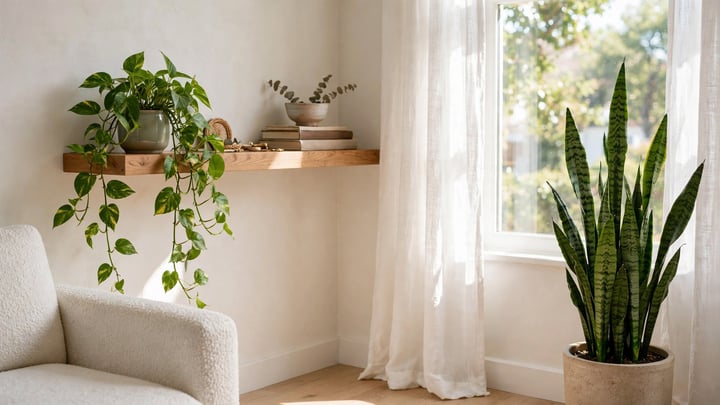
This guide walks through that order, plus the care basics that keep a plant alive past the first month, where to put plants in each room, and the pet check that should come before any shopping list.
Key takeaways
- Light comes first. A plant that needs bright indirect light won’t recover in a dark corner, no matter how carefully you water.
- Water by soil, not by calendar. Check the top 1 to 2 inches, water thoroughly when it’s dry, and let the excess drain away.
- Match the plant to your habits. Forgetful? Try a snake plant or ZZ plant. Prefer checking in often? Pothos and spider plants reward that.
- Pets or small children at home? Check toxicity before you buy, and confirm the exact botanical name.
- Plants aren’t a ventilation system. Buy them because they make a room feel better, not to fix stuffy air.
Start With Light, Not Looks
Light is the one thing you can’t make up for with extra care. A plant in too little light grows slowly, stretches toward the window, and stays wet longer because it isn’t using much water. A plant in harsh direct sun can scorch, especially one raised in a greenhouse or a shaded store aisle.
In the U.S. (the Northern Hemisphere), window direction gives you a useful first read. South-facing windows are usually the brightest. East- and west-facing windows give gentler light, stronger in the morning or the afternoon. North-facing windows are typically the dimmest. Distance matters as much as direction, though. The same plant right beside a bright window and eight feet back in the room is living in two different worlds.
Here’s a quick shadow check you can do at midday, standing where the plant will live. A sharp, clear shadow usually means bright light. A soft, fuzzy one suggests medium light. A faint shadow, or none, means low light. It’s a rough guide, not a measurement. If you want real numbers, a light meter or meter app will help, but most beginners do fine watching how the plant responds over two to three weeks.
Also, low light doesn’t mean no light. Almost every indoor plant still needs daylight. A windowless bathroom or hallway is a tough home for a living plant, even a snake plant or ZZ plant. In that case, a grow light is a real option. Otherwise, that spot may be better left plant-free.
Choose by Your Watering Habits
This filter is simpler than most guides make it. Ask yourself: do I forget to water, or do I check my pots every few days? Be honest. The plant only cares about what happens to its soil, not your good intentions.

If you forget to water or travel often, start with plants that tolerate drying out. Snake plants and ZZ plants are the usual first picks. They still need light and drainage, but they forgive a missed watering far more easily than a fern or a calathea.
If you enjoy checking in, pothos and spider plants are forgiving in a different way. They grow fast, show stress clearly, and bounce back from mistakes. A pothos with dry soil droops, then perks up after a drink. A spider plant sends out little plantlets you can snip and root, which makes it a fun first plant to propagate.
Monstera deserves a straight word. People buy it for its looks, but it wants medium to bright indirect light and plenty of room, and it will outgrow a small shelf quickly. Think floor spot with good light, not desk plant.
The table below shows commonly cited care ranges. Treat the timing as a starting point, not a schedule. Pot size, soil, light, and season will all shift the real timing.
| Plant | Light | Water when… | Pet note |
|---|---|---|---|
| Snake plant (Dracaena trifasciata) | Low to bright indirect | Soil is fully dry (often every 2-4 weeks) | Toxic to cats and dogs if chewed |
| ZZ plant (Zamioculcas zamiifolia) | Low to medium indirect | Soil is fully dry (often every 2-3 weeks) | Toxic to cats and dogs if chewed |
| Pothos (Epipremnum aureum) | Low to bright indirect | Top inch is dry (often every 1-2 weeks) | Toxic to cats and dogs if chewed |
| Spider plant (Chlorophytum comosum) | Bright indirect; tolerates medium | Top inch is dry (often weekly) | Commonly listed as non-toxic |
| Monstera (Monstera deliciosa) | Medium to bright indirect | Top 1-2 inches are dry (often every 1-2 weeks) | Toxic to cats and dogs if chewed |
| Peace lily (Spathiphyllum) | Low to medium indirect | Top inch is dry; leaves droop when thirsty | Toxic to cats and dogs if chewed |
| Boston fern (Nephrolepis exaltata) | Bright indirect | Keep soil evenly moist, not soggy | Commonly listed as non-toxic |
Note: Watering intervals here are typical ranges from common care guides, not a verified standard. Always check the soil first.
If you’re picking your very first plant and nothing else matters: choose a spider plant if you have pets, or a snake plant if you tend to forget to water. Both are affordable and easy to replace if the first one teaches you a hard lesson.
Watering: The Skill That Matters Most
Overwatering is the classic beginner mistake, and it’s easy to see why. Watering feels like caring. But for most indoor plants, constantly wet soil is worse than soil that dries out between drinks. Soggy soil starves roots of air and invites root rot, which is much harder to reverse than a plant that simply needed water.
Use the finger test every time. Push a finger 1 to 2 inches into the soil. Damp? Wait a few days and check again. Dry at that depth? Water. When you do, water thoroughly until it runs out of the drainage holes, then empty the saucer or cache pot so the plant isn’t sitting in standing water.
Three details make this work, and many guides skip them:
- The pot must drain. A pot with no hole can work for an experienced grower, but for a beginner it’s a trap. If you love a decorative pot without a hole, keep the plant in its plain nursery pot inside it, and lift it out to water and drain.
- Soil matters more than the watering can. Use a well-draining potting mix made for indoor plants. Garden soil compacts in a pot and stays wet too long.
- Season changes the rhythm. With more light and active growth in spring and summer, plants usually drink more. In fall and winter, growth slows and the same plant often needs far less. Extension specialists note that overwatering is especially common in winter, when plants rest, so check the soil rather than following last summer’s routine.
Sources: University of Kentucky Cooperative Extension, “Management Tips to Keep Houseplants Thriving” (Nov. 2025); Purdue Extension, “Four steps for thriving indoor plants.”
And one more thing: skip the little splash every day. It keeps the top of the soil damp while the deeper roots stay dry, so it looks like care without doing the job. A thorough soak followed by a real dry-down works better for most houseplants.
Soil, Pot Size, and Repotting
A plant doesn’t need a huge pot to be happy. In fact, a pot that’s too big holds extra soil that stays wet long after the roots have taken what they need. When it’s time to repot, go up only 1 to 2 inches in pot diameter. That’s the guidance from several university extension sources, including Purdue and UConn.

How do you know it’s time? Look for roots circling the bottom or poking out of the drainage holes, water rushing straight through, or growth that has stalled in the growing season despite good light. Plenty of plants are happy to stay put until they show you one of these signs.
Spring and early summer are the best times, since the plant is entering active growth and can recover quickly. A brand-new plant doesn’t need repotting the day you bring it home unless the pot has no drainage or the soil is obviously wrong for it. Let it settle in first. Repotting needs vary by plant, but many houseplants go roughly one to three years between repots, and fast growers like monstera may need it sooner.
Fertilizer is the other place beginners overdo it. Most indoor plants need less than the bottle suggests, and plants resting in winter need very little. Feed lightly during spring and summer growth, and ease off in fall and winter. Over-fertilizing can brown leaf edges. And if a plant looks yellow, stressed, or freshly repotted, fertilizer isn’t the fix. Light, water, and drainage come first, and a newly repotted plant should get several weeks to settle before you feed it.
Sources: Purdue Extension; UConn Home & Garden Education Center, “Green Thumb Secrets”; University of Kentucky Cooperative Extension.
Place Plants by Room, Not Just by Species
The same plant can thrive in one room and sulk in another, because light, humidity, and temperature change from room to room. Placement is where indoor plants stop being a shopping decision and become a design one.
Living room. Scale matters here. One small plant on a big empty shelf looks lost, while a tall floor plant in a corner can anchor a seating area. A trailing pothos on a high shelf fills vertical space without stealing floor space, a smart trade in a small room. If you’re also rearranging furniture, our guide to living room decor ideas for small spaces shows how to keep walkways clear while adding a floor plant.
Bathroom. Humidity suits ferns and pothos, but many bathrooms have small or frosted windows, so light is the real limit. A spider plant or pothos near a window with bright indirect light is a safer bet than a light-hungry plant. Keep it out of the direct splash zone, and make sure the pot still drains. Humidity helps, but it can’t replace light.
Bedroom. Bedrooms are often dimmer, especially if the curtains stay closed. Snake plants and ZZ plants fit well and don’t need daily attention. If pets sleep there, run the pet check below first, since both are toxic to cats and dogs if chewed.
Kitchen. Many kitchens get good light, but heat from the stove and cold drafts near doors can stress plants. Culinary herbs are a different category with their own water and light needs, so don’t give them the same routine as decorative plants. For a decorative pick, a pothos away from the stove beats a fern parked right beside it.
Small spaces and shelves. Trailing plants, wall-mounted planters, and one good floor plant usually look better than a scatter of tiny pots on every surface. A simple trick: aim for a range of heights, with one tall plant, one trailing plant, and one at table height. Without that variety, even three plants can look cluttered.
For a calm, natural look, plants pair well with wood, linen, and unglazed pots. It’s the same material logic behind Japandi living rooms, where a plant is one texture among several, not the only decoration in the room.

Pets and Children Come Before the Shopping List
Most list-style guides tuck this at the bottom. If it applies to your home, it belongs at the top.
Many of the easiest indoor plants are toxic to cats and dogs if chewed, including snake plant, ZZ plant, pothos, monstera, peace lily, and philodendron. That doesn’t mean you can never own them, but it does mean you need a plan for placement, not a hope that your pet will ignore them.
Plants commonly listed as non-toxic to cats and dogs include spider plant, Boston fern, parlor palm, peperomia, prayer plant (calathea), and African violet. But verify before you buy. Common names overlap, and a plant sold as a “palm,” “fern,” or “lily” may not be the species you think. Look up the botanical name on the ASPCA Toxic and Non-Toxic Plants list, and keep the plant tag until you’ve confirmed it.
Two cautions are worth keeping in mind:
- Non-toxic doesn’t mean edible. Any plant eaten in quantity can upset a pet’s stomach, and a determined chewer can still wreck a harmless plant.
- A high shelf isn’t a reliable barrier for a climbing cat. For persistent chewers, choose non-toxic plants and place them where they’re hard to reach, or keep plants in a room the pet can’t enter.
One more important distinction: a peace lily isn’t a true lily, and its effects are different from those of true lilies (such as Lilium and daylilies), which are especially dangerous for cats. If you share your home with a cat, keep true lilies out entirely, including in bouquets.
If a pet shows vomiting, drooling, pawing at the mouth, weakness, or unusual behavior after chewing a plant, call your veterinarian or the ASPCA Animal Poison Control Center at (888) 426-4435 right away. A consultation fee may apply. Don’t wait to see if it passes, especially if the plant is known to be toxic.

What the Leaves Are Telling You
Think of leaf signs as clues, not diagnoses. The same yellow leaf can have several causes, so use each sign to check light, water, and soil together instead of fixing one thing blindly.
- Yellow leaves, soft stems, soil that stays wet: often overwatering or poor drainage. Check the drainage hole, empty the saucer, and let the soil dry before watering again.
- Brown, crispy leaf tips: often dry air, uneven watering, or salts building up in the soil. Water consistently, and don’t overcorrect by watering daily.
- Leggy growth, small new leaves, leaning hard toward the window: usually too little light. Move the plant closer to brighter light gradually, not straight into harsh sun.
- Drooping that perks up after watering: a thirsty plant (peace lilies are famous for this). If it doesn’t improve after watering, check for root problems or soil so dry it repels water.
- Tiny flies around the soil: likely fungus gnats, which thrive in constantly wet topsoil. Letting the top layer dry between waterings is the first step, before any spray or trap.
If a plant keeps declining despite good light and watering, check the roots. Healthy roots are firm and light-colored. Mushy, dark roots point to rot. The fix is to trim the damaged parts, repot into fresh, well-draining mix, and water much less until it recovers. That’s a rescue, not a routine. Catching the problem early by checking the soil beats waiting for the whole plant to collapse.
Common Mistakes (and How to Dodge Them)
- Buying five plants at once. That means learning five care routines at the same time. Start with one or two, see how they do in your home, and add more once they’ve been stable for a month or two.
- Moving a plant every few days. Chasing better light or a better photo stresses it. Plants adjust slowly, so give a new spot two to three weeks before judging it, unless the plant is clearly scorching.
- Trusting the tag alone. Tags are generic, and the same species can need different care in a bright apartment and a dark one. Use the tag as a starting point, then adjust to your soil, light, and the plant’s response.
- Treating every plant the same. A snake plant and a fern in one room still need different watering. Group plants by care needs, not just by looks.
FAQ
Can indoor plants live without sunlight? Not for the long term. Low-light plants tolerate dimmer conditions, but they still need daylight. A windowless room needs a grow light if you want a living plant there.
Are indoor plants good for air quality? They can make a room feel fresher and more pleasant, but a few pots won’t replace ventilation or an air filter. If air quality is your main goal, fresh air, cleaning, and cutting indoor pollution sources matter more.
How often should I repot an indoor plant? Only when it needs it, which for many plants is every one to three years. Look for roots circling the bottom, water running straight through, or stalled growth in the growing season despite good light. Move up only 1 to 2 inches in pot diameter at a time.
A Simple Place to Start
Pick one spot. Check its light at midday. Choose one plant that fits that light and your watering habits. Give it a draining pot, a good potting mix, and two to three weeks to settle before you judge it.
If it grows, add a second plant with similar needs. It’s a slower start than a full shelf on day one, and it’s the reason the second shelf usually survives.
Keep reading



Leave a Reply
You must be logged in to post a comment.