
Japandi blends two traditions that agree on almost everything. From Japan it takes minimalism, low furniture and a real respect for empty space. From Scandinavia it takes warmth, natural materials and practical comfort. Put them together and you get a living room that feels calm without feeling cold, and simple without feeling empty.
Most Japandi rooms go wrong in the same few ways. The palette turns stark white and chilly, the furniture sits at standard height, or the owner buys a dozen small accessories instead of a few good pieces. The 12 ideas below follow the order in which the decisions actually matter: space first, then palette, furniture, texture, light and, last of all, objects.

What Makes a Room Japandi (and Not Just Minimal)?
Four things separate Japandi from generic minimalism:
- Low furniture. Pieces sit close to the floor, in the Japanese tradition.
- A warm palette. Think off-white, greige, sand and clay, not bright white and cool gray.
- Natural materials you can see. Wood grain, linen weave, clay and stone.
- Empty space as part of the design. The gaps between objects are chosen, not left over.
Miss any two of these and the room reads as Scandinavian, modern, or just beige. It won’t read as Japandi.
The 12 Ways
1. Start by removing, not buying
The first step costs nothing and does more than any purchase: take out everything that hasn’t earned its place. A Japandi room holds noticeably fewer objects than a typical living room, and the ones that stay are larger and more deliberate.
Clear the coffee table, the shelves and the floor. Live with the emptiness for a few days. Then bring back only what you actually missed. The usual trap is treating minimalism as permission to scatter lots of little things around. Twenty tiny objects read as clutter at any budget.
2. Build the palette on warm neutrals
Start with warm off-white, greige, sand and clay. Pure bright white is the most common palette mistake, because under daylight it turns a Japandi room cold and clinical. Keep accent colors muted and earthy: sage, soft charcoal, a touch of deep brown.
Contrast should come from pairing light surfaces with a few dark pieces, not from adding a new hue. And if you rent and can’t repaint, you can carry the same palette through the sofa, rug, curtains and cushions.
3. Choose a low-profile sofa
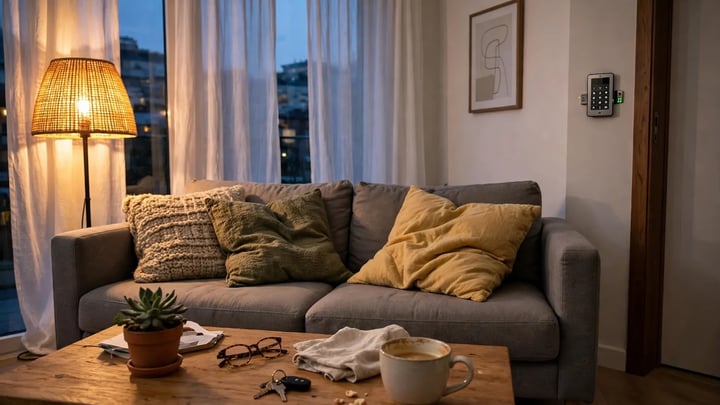
The sofa sets the room’s height line, and in Japandi that line runs low. A standard sofa has a seat height of about 17 to 19 inches. Low-profile models commonly sit around 14 to 16 inches, so look for something in that range, ideally with a simple wood frame or short wood legs. Upholstery in linen, cotton or low-pile bouclé works well in oatmeal, mushroom or another warm neutral.
Skip tall backs, rolled arms and ornate legs. They belong to other styles and fight everything else in the room.
One honest caution: very low seating is harder for older guests and for anyone with bad knees. Comfort outranks silhouette, so sit on the sofa in a showroom before you buy it, especially if family visits often.
Source note: the 17 to 19 inch standard comes from Bob Vila’s coffee table height guide. The 14 to 16 inch low-profile range is a typical retailer figure (for example, Ash Deco’s sizing guide), not an industry standard, so always check the spec sheet of the exact sofa.
Once the sofa is chosen, the rest of the room follows from it. Our guide to modern living room furniture covers the essential pieces that sit well with a low profile and warm neutrals.
4. Anchor the seating with a low, solid-wood coffee table
If your budget allows one real investment, make it a solid wood coffee table in oak, ash or walnut. Keep the top level with the sofa seat or 1 to 2 inches below it, so the proportions stay grounded. That’s the same rule most furniture guides give: a standard table runs 16 to 18 inches tall, and it should never sit higher than the seat cushions. With a 14-inch seat, for example, Bob Vila suggests a 12 or 13 inch table.

A rectangular table with clean edges suits most rooms. A round one softens a small seating area and takes the corners out of the walkway. Avoid glossy finishes and printed wood grain. In this style the material is the decoration, and fake grain gives itself away at arm’s length.
5. Layer textures, not colors
A neutral room with one texture looks flat. The same room with five textures looks rich. Stay inside your palette and vary the surfaces instead: a linen throw over a wool cushion, a jute or wool rug underfoot, a matte ceramic vessel on raw wood.
This is the Scandinavian half of the style doing its job. Hygge, the Danish idea of everyday coziness, comes through touch far more than through color.
6. Ground the seating area with one large rug
One large, low-pile rug in wool or a natural fiber defines a conversation area better than two small ones. For a typical living room, an 8×10 ft rug is the usual starting point, placed so at least the front legs of the sofa and chairs rest on it (HOM Furniture rug guide). Larger or open-plan rooms often need 9×12 ft.
Keep the color inside your palette, such as oatmeal, sand or soft greige, and let the weave supply the pattern. A busy patterned rug is one of the fastest ways to wreck the calm this style depends on. Before you order, mark the rug’s outline on the floor with painter’s tape and check that the sofa and chairs land where you expect.
7. Add a few dark elements for contrast
An all-pale room has no depth. Japandi uses black and dark brown sparingly, as grounding: a matte black vase, thin dark picture frames, a walnut side table against pale oak.
A useful reference is the classic 60-30-10 color rule, which gives the accent roughly 10 percent of a room. Treat it as a starting point, not a law. Designers openly say it’s meant to be bent. Too much dark and the room turns moody; none at all and it turns bland. Make the dark pieces the best-made things in the room, because the eye goes to them first.
8. Light it soft, low and warm
One bright ceiling light ruins more Japandi rooms than any furniture mistake. Build the lighting from several soft sources instead: a paper or lantern-style pendant over the seating area, a floor lamp with a linen shade in the reading corner, a small table lamp on the sideboard.

For the bulbs, aim for warm white. Lighting makers and designers commonly point to 2700K for living rooms, with up to 3000K also considered warm white (Feit Electric; Ideal Home). Use the same color temperature in every lamp in the room, because mixing warm and cool bulbs looks off.
During the day, sheer linen curtains beat blackout blinds. They filter the light and keep the room connected to the outdoors.
9. Use one sculptural plant, not five small ones
A single architectural plant, such as an olive tree, a fiddle leaf fig or a well-shaped bonsai, does what a shelf of small pots can’t. It gives the room a focal point with a real silhouette. Plant it in a matte ceramic or terracotta pot that matches your palette.
If the room gets little natural light, one good-looking faux plant in a quality pot beats a real one slowly failing in the corner. The style asks for signs of life, not signs of struggle.
10. Choose handmade pieces and let them be imperfect
Wabi-sabi, the Japanese appreciation of imperfection, is your permission slip for the objects in the room: a hand-thrown bowl with an uneven rim, a wooden stool with visible grain and a repaired crack, a woven basket that isn’t quite symmetrical.

Fewer and larger beats many and small, on the coffee table as much as anywhere else. One vessel and a short stack of books is a complete coffee table arrangement in this style.
Handmade pieces with a past fit this look better than anything new and flawless. Our guide to vintage home decor shows how to mix old pieces with modern style without losing the calm.
11. Hide the everyday behind closed storage
Minimalism falls apart in the first week if everyday things have nowhere to go. A long, low sideboard with closed doors, in the same wood family as the coffee table, swallows remotes, chargers, games and paperwork.
The TV needs the same care. Mount it low over the console or set it on top, hide every cable, and keep the wall around it empty. A black screen floating alone on a bare wall with wires showing is the one arrangement that reliably breaks the room’s calm.
12. Divide open space with slats or an open screen
Open-plan rooms sometimes need separation without building a wall. A wood slat screen, inspired by Japanese shoji and lattice work, divides the living area from the dining space while still letting light through. An open-backed bookcase set at a right angle to the wall does the same job and gives you storage too.
Keep whatever stands on a divider sparse. One crowded with objects becomes the clutter it was meant to contain.
Mistakes That Break the Look

Buying a matching furniture set. A sofa, table and shelving unit from one collection guarantees coordination and kills character. Pieces that share proportions, wood tone and palette work together without matching.
Going all beige. Pale on pale, with no dark accent and no texture contrast, is the flat, unfinished version of this style. Add depth with a darker wood or a charcoal piece before you buy more decor.
Choosing style over sitting. A gorgeous low sofa nobody can climb out of, or a delicate rug under a dog and two toddlers, fails the way the room is actually lived in. The calm comes from things working, not from things posing.
Rushing it. A room assembled in one weekend shopping trip looks assembled. This style rewards slow collecting: the right table this year, the right lamp later.
Building the Room, in Order
Work through the list in sequence, and stop when the room feels calm rather than when the list runs out.
Start with the palette, because it disciplines every later choice. Then add the sofa, the table and the rug, the three pieces that set height and scale. Then light. Objects come last, one at a time, with the discipline to leave a shelf empty until something good enough turns up.
That restraint is the whole style. A Japandi living room isn’t a room with Japanese and Scandinavian things in it. It’s a room where every item was chosen, and so were the spaces between them.
Planning a smaller space? See our guide to small living room ideas. Still choosing furniture? Our guide to modern living room sets is a good next read.





Leave a Reply
You must be logged in to post a comment.