
A Christmas table has one job that no other table in the house has: it has to look like a celebration and still work like a table. Guests need elbow room, serving dishes need space to land, and everyone needs to see each other across the centerpiece. The tables that fail usually fail on one of those three things, not on a lack of decoration.
The fix is order, not more stuff. Start with the base layer, build each place setting the same way, then add a centerpiece that stays low and narrow. This guide covers 12 Christmas table decoration ideas that follow that order, plus the measurements that keep the table working through a long dinner.
Three Rules Before You Decorate
First, allow about 24 inches of table width per person. That is the comfortable guideline used by US table setting guides, and it leaves room for elbows, glasses, and a serving dish passed hand to hand. Measure the table before counting chairs. A six foot table seats six comfortably at 24 inches each, not eight.
Second, keep the centerpiece under about 12 inches tall. Anything solid in the center should stay below that height so guests can talk across the table. Slim pieces like taper candles can go higher, because people can see around them. A tall vase or a big arrangement in the middle turns dinner into a conversation with a wall.
Third, build the table in layers from the bottom up: cloth or runner, then each place setting from the largest plate upward, then the centerpiece last. Decorating in that order keeps the centerpiece from dictating where plates go, which is how tables end up crowded.
12 Christmas Table Decoration Ideas
1. Start With a Runner Instead of a Full Cloth
A runner down the center of the table does the work of a tablecloth without covering the wood. It anchors the whole look, gives the centerpiece a bed to sit on, and leaves the table surface visible at the edges, which keeps the table from looking heavy.
A red runner on a cream cloth makes red the theme. A plain cream cloth with red napkins lets red come in as an accent instead. Either way, pick one approach and stick to it. A runner in one color, a cloth in a second, napkins in a third, and plates in a fourth is how a table starts to look busy before a single dish arrives.
On a bare wooden table, a runner also protects the center where hot dishes and candle wax land. Linen and cotton runners wash well, and a runner costs far less than a full cloth in the same fabric, which matters when the table is long.
2. Layer a Charger Under Everyday Plates

A charger is a large flat plate that sits under the dinner plate and stays on the table through the meal. It adds a layer of depth to a place setting and it is the easiest way to make everyday plates look dressed for Christmas.
Silver chargers are the classic choice, but gold chargers pick up candlelight and suit a warm red and gold table, while woven rattan chargers suit a rustic table with greenery. The charger itself carries no food, so it can be bolder than the plates it frames.
Set the charger first, centered about an inch from the edge of the table, then the dinner plate on top. A 10 inch dinner plate on a 13 inch charger is a common pairing. Keep every setting identical, because one different charger is all it takes for a guest to wonder if they got the wrong seat.
3. Build a Low Greenery Centerpiece

A line of fresh greenery down the center of the runner is the most forgiving centerpiece there is. Lay cedar, pine, or fir branches loosely along the runner, overlap the ends so the line looks continuous, and leave gaps where serving dishes will sit.
Fresh greenery smells like Christmas in a way no candle can match, and it costs little. If fresh branches are hard to find, faux eucalyptus or fir garland works the same way and can be reused next year. Mix one or two types of greenery rather than five, because a mixed tangle reads as clutter from across the table.
Tuck pinecones, red berries, or small ornaments into the greenery for texture, but keep the whole arrangement under about 12 inches tall and narrow enough that serving dishes fit on either side. The greenery is the bed. The candles and ornaments are the accents, not the other way around.
4. Vary Candle Heights Down the Middle
Candles are what make a Christmas table feel warm after the food is served, and height variation is what makes them look deliberate. Place candles of different heights along the center of the table, in glass holders, brass holders, or simple ceramic ones, so the light moves instead of sitting in a flat line.
A set of three taper candlesticks at different heights, for example 9, 11, and 13 inches, gives rhythm without blocking sightlines, because tapers are slim enough to see around. Pillar candles in hurricane glass work better on a table with children, because the glass shields the flame.
Keep open flames away from paper runners, napkins, and dry greenery. Flameless LED candles are a stress free option for a long dinner: they will not drip on the runner, flicker out in a draft, or set a stray napkin alight, and they can sit right in the greenery without worry.
5. Fold the Napkin Around a Sprig of Rosemary
A napkin folded with a sprig of rosemary tucked under the fold is a small detail with a big return. It costs almost nothing, it smells good when a guest picks it up, and it turns an everyday napkin into a place setting that looks thought through.
Fold the napkin into a simple rectangle or a loose pocket, lay it on the plate or to the left of the forks, and slide the rosemary under the top fold. A length of twine or a thin ribbon tied around the fold holds the sprig in place and adds a handmade touch. Eucalyptus, a cinnamon stick, or a small pine sprig work the same way.
Keep the sprig small. A branch that sheds needles onto the plate is a detail that fights the meal. One short sprig, about 4 inches, is enough for the scent and the look.
6. Give Every Guest a Handwritten Name Card
A handwritten name card does two jobs at once: it tells guests where to sit, and it tells them they were expected. Write each name by hand, even if the handwriting is not perfect. A printed card in a careful font is fine, but handwriting reads as personal in a way print does not.
Place the card on top of the napkin, beside the plate, or above the setting. A small shatterproof ornament makes a charming name card holder and a gift guests can take home: write the name on a tag, loop it on the ornament, and set it above each plate. Pinecones, candy canes, or a sprig of rosemary can hold a card the same way.
Write the names the way each guest likes to be called, not the formal version on an envelope. A card that says “Grandma” instead of a full name is a small kindness that guests notice.
7. Pick Two Colors and One Metal

A Christmas table looks pulled together when it commits to two colors and one metal. Red and green is the classic pairing. Cream with deep green or soft gold reads quieter and more formal. Red and gold is warm and traditional. The pairing matters less than the discipline of stopping at two.
A useful ratio is about one part of the bold color to three parts of the quiet one, with the metal tying the two together. A red runner on a cream cloth, red napkins, and gold flatware follows that ratio. A table that gives equal weight to red, green, gold, and silver has no quiet place for the eye to rest, and the food stops standing out.
Repeat the two colors in at least three places each: the runner, the napkins, and the centerpiece for one color; the plates, the glasses, and the name cards for the other. Repetition is what makes a limited palette look intentional instead of accidental.
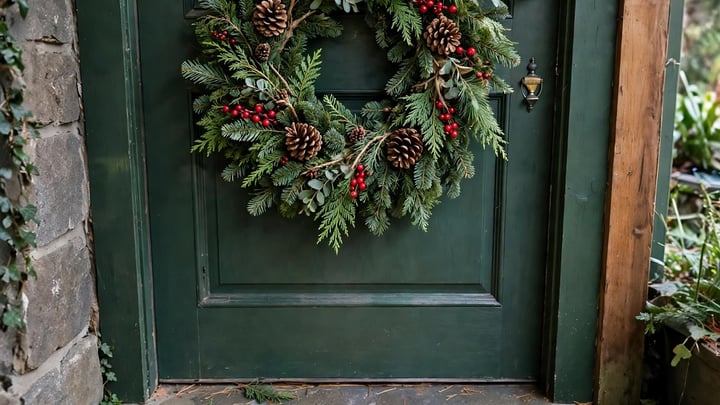
8. Lay a Small Wreath Flat as the Centerpiece

A small wreath does not have to hang on the front door. Lay one flat in the center of the dining table and put a few candles or a decorative bowl in the middle, and it becomes a centerpiece that is already the right shape: low, round, and contained.
A wreath centerpiece works best on a round table or a square one, where a long greenery line would look wrong. On a long rectangular table, use two or three small wreaths spaced along the runner instead of one big one, with a candle in the middle of each.
Keep the wreath to about 12 to 14 inches across for a standard table, so it leaves room for plates and serving dishes on either side. A wreath that spreads across the whole width of the table is a centerpiece that ate the serving space.
9. Set One Place Just for the Kids

Children eat better and sit longer at a table that has something for them. Set one end of the table, or a small side table, as the kids place: a paper placemat they can draw on, a small treat at each setting, and plates that can survive a knock.
Use shatterproof ornaments and LED candles at the kids end, and skip glass chargers there. A Santa shaped napkin, a small stocking with a candy cane, or a name card with a drawing on the back gives a child something to look at while the adults talk.
Seat the kids together at one end rather than scattered between adults. They entertain each other, the adults can talk, and the table stays calmer for everyone. A common mistake is seating a child between two adults who then spend dinner managing the child instead of eating.
10. Add Fruit, Pinecones, and Nuts for Texture
Fruit, pinecones, and nuts are the cheapest texture on a Christmas table, and they fill the gaps in a greenery centerpiece without adding another color. A bowl of clementines, a scatter of walnuts in their shells, and a few pinecones tucked into the greenery give the table a natural, abundant feel.
Clementines and small oranges work best because they are bright, round, and edible. Whole nuts in shells double as a snack and a decoration, and they do not wilt during a long dinner. Pinecones add height and a woodland note, but keep them away from open flames, because dry pinecones catch fast.
Do not mix fruit with glitter or spray snow. The point of natural texture is that it looks real next to the food. A clementine dusted with fake snow looks like a prop, and a prop is the opposite of a feast.
11. Weave Fairy Lights Through the Greenery
Fairy lights woven through the centerpiece greenery give a Christmas table its glow without a single open flame. Battery operated strands are the practical choice, because they need no outlet and the battery pack hides under the greenery at the end of the table.
Weave the lights loosely through the branches rather than wrapping them tight. A loose weave lets the light show in gaps instead of disappearing inside the greenery, and it keeps the wire from pulling branches out of shape. Warm white lights suit a traditional table; cool white suits a white and silver one.
Turn the fairy lights on before guests sit down, and keep them on a timer if the dinner runs long. A strand that dies halfway through dessert is worse than no lights at all, so check the batteries the day before, not an hour before dinner.
12. Leave Gaps for the Serving Dishes
The last idea is the one most tables forget: leave gaps for the serving dishes. A centerpiece that runs the full length of the table with no breaks leaves nowhere for the turkey platter, the gravy boat, or the salad bowl to land, and the meal becomes a juggling act.
Plan the gaps before decorating. Set the serving dishes on the bare table first, mark where they go, then build the centerpiece around those spots. Two or three gaps along a long table are usually enough, and the greenery can run in segments between them instead of one unbroken line.
A table that leaves room for the food is a table that was decorated for dinner, not for a photograph. Guests remember the meal, not the centerpiece, and a centerpiece that gets in the way of the meal is decoration that failed at its job.
How to Lay the Table, Step by Step
Lay the table in the same order every time, and it takes half the time. Start with the runner down the center, then build each place setting from the bottom up.
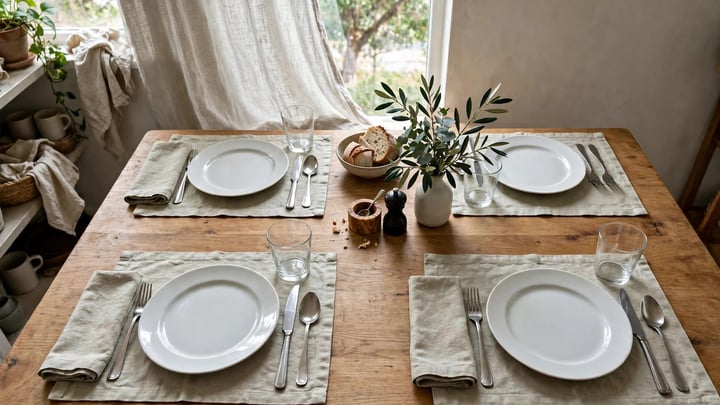
Center a 10 inch dinner plate in front of each chair, about an inch from the edge of the table. If you are using chargers, the dinner plate sits on top of the charger. Layer an 8 inch salad or dessert plate on top of the dinner plate when you are serving a starter. That smaller plate is the easiest place to bring in a second pattern, like plaid or a shaped plate, without the table looking busy.
Forks and the napkin go on the left. The knife goes on the right with the blade facing the plate, and the spoon sits to the right of the knife. Glasses go just above the knife, with the water glass first, then red wine, then white. Tuck a sprig of greenery or a name tag into the folded napkin for the holiday touch.
Lay one setting first and check the spacing before doing the rest. At about 24 inches per person, a six foot table seats six. If the settings feel crowded at that spacing, the table is too small for the guest list, and no amount of decoration will fix it.
Frequently Asked Questions
How tall should a Christmas table centerpiece be?
Keep it under about 12 inches tall. That height lets guests see each other across the table while still giving the centerpiece presence. Slim pieces like taper candles can go higher, because people can see around them. A tall vase or a large arrangement in the middle blocks conversation and crowds out serving dishes.
How much table space does each guest need?
Allow about 24 inches of table width per person. That leaves room for elbows, glasses, and a serving dish passed hand to hand. A 10 inch dinner plate with an 8 inch salad plate on top, plus cutlery and glasses, fills most of that width, so anything less than 24 inches per person feels cramped by dessert.
Can I use real candles on a Christmas table?
Yes, with two rules: keep open flames away from paper runners, napkins, and dry greenery, and never leave a lit candle unattended. Taper candles in stable holders and pillar candles in hurricane glass are the safest choices. Flameless LED candles give the same warm light with none of the risk, and they can sit directly in greenery.
Conclusion
A festive Christmas table is built in layers, and the layers have an order: runner first, place settings second, centerpiece last. Two colors, one metal, a centerpiece under 12 inches, and 24 inches per person. The rest is detail, and detail is where the table becomes yours: a sprig of rosemary in the napkin, a handwritten name card, a wreath laid flat in the middle. Leave room for the serving dishes, light the candles before guests sit down, and the table will do what it is for: hold a feast.



Leave a Reply
You must be logged in to post a comment.