
Most Christmas tree decorating ideas show you a finished tree and skip everything that got it there. Which theme works with the room you actually have? How many ornaments does a tree this size take? How much ribbon should you buy before the spool runs out halfway down?
This guide covers eight themes that are popping up everywhere this season. Each one comes with a palette, a shopping list and an honest weak spot. We’ll start with the numbers, since they’re the part most roundups leave out.
Before You Pick a Theme: Three Checks
Match the room, not the photo. Your tree will live with your sofa, wall color and flooring for a month. Warm, wood-heavy rooms handle deep colors and aged metals well. White and gray rooms can carry icy or pastel looks that would feel lost against dark paneling. If the room already has a strong color story, let the tree echo one of those colors rather than introducing a new one.
Measure the ceiling before you shop for a tree. Plan on leaving 6 to 12 inches between the top of the topper and the ceiling (retailers differ, but 12 is the safe end). Under a standard 8-foot ceiling, that usually means a tree of about 6.5 to 7 feet once the stand and topper are counted, whatever the box promises.
Source notes: Balsam Hill recommends about 12 inches of clearance; Wayfair gives a 6 to 12 inch range and suggests a 7-foot tree for an 8-foot ceiling with a topper (Wayfair tree size guide); King of Christmas is more conservative at 6 to 6.5 feet (kingofchristmas). Brands also measure height differently, so check whether the stand is included.
Width matters just as much. A standard full-profile tree runs roughly 4 to 5.5 feet across, which is a lot of furniture in a small living room. (Source: Wayfair tree size guide, linked above.) Leave a few inches between the branches and the nearest wall, and keep it away from radiators and fireplaces.
Decide your budget order. Lights and ribbon shape the whole tree, and ornaments fill in what’s left. If money is tight, spend on lights first, ribbon second and ornaments last. A well-lit tree with modest ornaments looks finished. The reverse rarely does.
How Many Lights, Ornaments and Ribbon Does a Tree Need?
These are the working ranges retailers and decorating guides keep coming back to. They assume a full-profile tree and standard 3 to 4-inch ornaments.
| Tree height | Mini lights (~100 per ft) | Ornaments (standard look) | Garland or ribbon |
|---|---|---|---|
| 5 ft | about 500 | 50–75 | 45–50 ft |
| 6 ft | about 600 | 60–90 | 54–60 ft |
| 7 ft | about 700 | 70–105 | 63–70 ft |
| 7.5–8 ft | about 750–800 | 75–120 | 68–80 ft |
A few notes on reading it:

Lights. One hundred mini lights per foot of height is the usual starting point, and a very full tree or a brighter look pushes that to about 150 per foot. Pre-lit trees settle this for you, which is partly why they cost more. (Source: Wayfair lighting guide.)
Ornaments. The range comes from the common rule of 10 to 15 standard ornaments per foot for trees under 9 feet. (Source: Christmas Central.) A deliberately full, layered tree goes higher. Crate & Barrel, for example, suggests around 84 as a minimum for a 7-footer and roughly 168 for really full coverage. Oversized ornaments (5 inches and up) fill more space each, so buy toward the low end and add a few statement pieces.
Garland and ribbon. The most common rule is about 9 feet per foot of tree height, which gives roughly 63 feet for a 7-footer. (Source: Christmas Central, linked above.) Go toward 10 feet per foot if you like it draped heavy. Thick garland covers ground faster than thin ribbon, so a chunky 6-inch garland sits at the low end.
Slim trees break the table. Ornament and garland counts follow width more than height. A slim 7-foot tree often needs only 40 to 60 ornaments, closer to what a standard 5-footer takes. (That figure is a planning estimate based on width, not a published standard.)
The Themes
Every shopping list below is scaled for a full 7-foot tree. Scale down with the table if yours is smaller. Quantities per theme are planning estimates built from the ranges above.
1. Jewel-Tone Maximalist
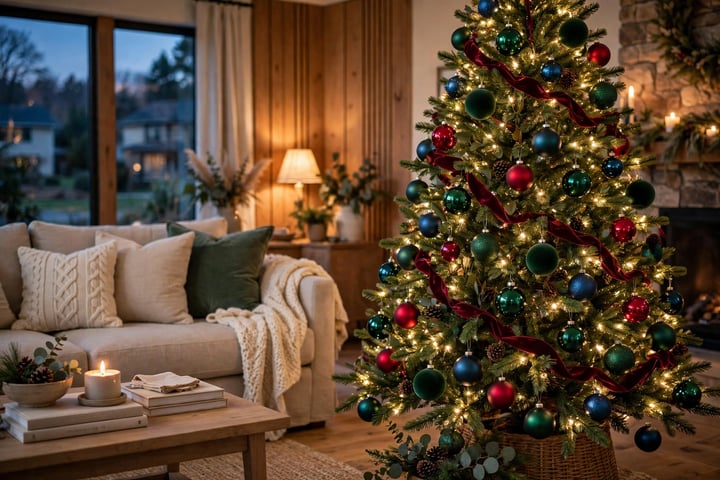
Emerald, ruby and sapphire, layered deep, with gold as the filler that ties the colors together. Burgundy or forest green velvet ribbon finishes it. It’s the loudest theme here, and it photographs best at night, when the dark colors glow against warm light.
Buy: 80 to 100 ornaments split across the three jewel colors, in at least two finishes each (matte and glossy, or glossy and glitter). Add 15 to 20 plain gold ornaments tucked deeper in the branches, plus about 63 feet of velvet or satin ribbon.
Cost: Moderate to high. Jewel-tone glass costs more than basic sets, though shatterproof versions bring the price down.
Best for: Living rooms with neutral furniture that can take the color, and trees 7 feet or taller.
Skip it if: The room is already colorful or heavily patterned. The tree will fight the room and both lose. Dark colors also make a small tree look smaller.
2. Metallic Luxe
Gold, champagne and bronze in mixed finishes. One rule decides whether this looks rich or cheap: warm white lights only, around 2,700K. Cool white flattens gold and turns champagne gray.

Buy: 70 to 90 ornaments with one metal clearly in the lead, roughly a 60/40 split, so the tree reads as gold with accents rather than a mix with no point of view. Add about 63 feet of metallic or sheer gold ribbon.
Cost: Moderate. Metallic shatterproof sets are inexpensive, and the price climbs if you switch to glass.
Best for: Almost any living room. It’s the safest pick for a main family tree.
Skip it if: Your room is committed to silver, chrome and cool daylight bulbs. Two metal families and two light temperatures on one tree looks like a mistake.
3. Icy Blue and Silver
Pale blue, silver, white and clear glass, with icicle shapes doing most of the work. Where the metallic theme wants warmth, this one wants cool white lights to keep the blue clean.
Buy: 70 to 90 ornaments. Include a set of icicle or drop ornaments, because those elongated shapes are what separate this from a generic blue tree. Add silver ribbon or silver bead garland, about 63 feet.
Cost: Moderate.
Best for: Modern rooms, white and gray interiors, and coastal homes where blue already shows up in the decor.
Skip it if: The room is traditional and wood-heavy. Blue and silver next to a lot of warm oak or cherry can feel cold rather than wintry.
4. All-White Winter
White on white, and the whole look depends on texture. Matte, glossy, iridescent, flocked and feathery finishes have to stand in for color contrast. A tree done in a single white finish looks unfinished from across the room.
Buy: 80 to 110 ornaments, more than most themes, because low contrast needs more pieces to register. Mix at least three finishes. Ribbon is optional; about 63 feet of sheer white or ivory works if the tree looks bare without it.
Cost: Low to moderate for ornaments. A flocked tree costs more than a plain green one if you’re buying the tree itself this year.
Best for: Small rooms, where a bright tree adds light instead of bulk, and Scandinavian-style interiors.
Skip it if: The room is white walls, a white sofa and a pale rug. The tree will vanish. Add a wood tree collar or a deep green garland somewhere nearby to give it something to stand against.
5. Foraged and Natural
Dried orange slices, pinecones, wooden beads, cinnamon sticks and burlap or linen ribbon. This has the lowest cash cost and the highest time cost, and it’s upfront about both: drying orange slices takes hours in a low oven, and the results last a season or two, not a decade.
Gather: 50 to 70 pieces is plenty, because natural pieces are chunky and fill space quickly. Layer two or three strands of wood bead garland with burlap ribbon instead of a full ribbon wrap.
Cost: Low in money, high in time.
Best for: Farmhouse and rustic rooms, wood-heavy interiors, and households trying to avoid plastic decor.
Skip it if: You want a tree you can decorate once and repeat unchanged for ten years. Dried fruit needs checking every season, replacing when it dulls or breaks, and storing sealed.
If you would rather make these than buy them, our guide to DIY Christmas ornaments walks through 12 handmade projects, from dried orange slices to yarn-wrapped baubles.
6. Moody European
Burgundy, deep green and aged brass, with velvet ribbon and candle-style accents, either clip-on candle ornaments or warm candle-glow lights. The look borrows from old European hotel lobbies: all depth and shadow.
One practical fix: dark ornaments absorb light instead of reflecting it, so plan on about 150 lights per foot rather than 100, or the tree goes flat by evening. (That’s a working estimate, in line with the upper end of the range in the lighting guides.)
Buy: 70 to 90 ornaments in deep colors with antique or brushed finishes, nothing shiny-bright. Add velvet ribbon in burgundy or dark green, about 63 feet.
Cost: Moderate to high. Velvet ribbon and aged-metal finishes sit above basic sets.
Best for: Dining rooms, rooms with dark painted walls, and homes with traditional architecture.
Skip it if: The room is small, north-facing and already short on daylight. A dark tree in a dark corner reads as a black shape for most of the day.
That aged, collected feel works beyond the tree. Our guide to vintage home decor shows how to mix old pieces with modern style in the rooms around it.
7. Pink, From Pastel to Fuchsia
Two versions share this slot. Pastel pink with white and gold is soft and suits bedrooms. Fuchsia with silver is a deliberate statement and suits almost nothing else in the room, which is the point.

Buy: 70 to 100 ornaments. Keep a second color in the mix, since one shade of pink at this count goes flat. Gold warms the pastel version and silver sharpens the fuchsia one.
Cost: Low to moderate.
Best for: Bedrooms, a second tree, and white rooms that need one strong color.
Skip it if: It’s the household’s only tree and not everyone is sold. Pink is the most polarizing color on this list. Give it a bedroom tree of its own rather than arguing over the main one.
8. The Bow Tree
Oversized bows in place of a heavy ornament load: one large bow where the topper would go, smaller bows wired down the branches, and plain filler ornaments behind them. Bows are getting a lot of attention for this season, and the theme is also the easiest to store, since a bag of ribbon takes up a shelf corner instead of a bin.
Buy: 15 to 25 bows for a 7-foot tree, plus 30 to 40 plain ornaments in one neutral metal as background. Plan on about 2 yards of wired ribbon per large bow (a hand-made estimate), and buy wired ribbon only. Unwired ribbon droops by day two.
Cost: Low. Velvet wired ribbon costs more than satin but holds its shape far better.
Best for: Slim trees, minimalists, and anyone tired of untangling and storing ornament boxes.
Skip it if: You want sparkle. Bows are matte and soft, so the tree reads quiet. That suits some rooms and disappoints in others.
Small Spaces: Slim Trees and Tabletop Trees
The advice above assumes a full tree. Apartments usually have something narrower, and narrower changes the math more than the theme does.
Slim and pencil trees. Work from the low end of every range in the table, or below it. A slim 7-footer with 40 to 60 ornaments looks dressed, while the same tree with 105 looks stuffed. Ribbon works better as vertical cascades down the front than as a full wrap, and cascades use far less of it. The bow tree, all-white and metallic luxe themes all read well at a lower ornament count, so they’re the strongest picks.
Tabletop trees (2 to 3 feet). Scale the ornaments down, not just the count: 1 to 2-inch ornaments, roughly 20 to 30 of them, and one short strand of battery fairy lights. A tabletop tree in a bold theme like jewel tones or moody burgundy makes a better hallway or bedroom accent than a mini copy of the main tree.

The most common mistake is judging a slim tree by the standard table and buying double what it needs. Buy for the width in front of you, then add more only if the decorated tree still shows gaps.
Mistakes That Undo a Themed Tree
Decorating only the branch tips. Hang the largest ornaments deep near the trunk, medium ones mid-branch and the smallest at the tips. That layering gives a tree depth. A tree decorated only on the surface looks thin no matter how many ornaments it carries.
Mixing light temperatures. Warm white and cool white strands on one tree clash, and no theme survives it. Check the box before buying a second strand. Use warm for gold, jewel and moody themes, and cool for icy blue.
Buying one matched set and stopping. A single boxed set in one size and finish is the fastest route to a flat tree. A collected look works better: a base in one color family, then a handful of mismatched pieces in different sizes and shapes.
Forgetting the topper when measuring. A tall star or angel can add 8 to 12 inches above the tree’s listed height. Trees are sold by height without the topper, and ceilings don’t negotiate.
How to Choose Your Theme
Start with the room, then the tree. For a neutral living room and a main family tree, go with metallic luxe or jewel tones. For a small or narrow space, a slim tree with bows or an all-white scheme. For a room with dark walls, moody European, with the extra lights in the budget. Then buy in the order that shapes the tree: lights, ribbon, ornaments.
Use the table as the core of your shopping list and buy ornaments toward the low end first. A themed tree can always take ten more ornaments next week. It can’t easily give back the forty you didn’t need.
Read more:
- 30 Christmas Decoration Ideas for 2026
- Christmas Mantel Decor Ideas: Styling Your Fireplace
- 15 Small Living Room Ideas



Leave a Reply
You must be logged in to post a comment.