
Most living rooms fail at lighting in the same quiet way. One bright ceiling fixture does all the work, so evenings feel flat, reading strains the eyes, and guests gather under a glare instead of a glow. The furniture can be right and the colors can be right, and the room still feels unfinished after dark. Light is what makes a living room feel like a place to stay.
These 12 ideas cover the full range of living room life: slow evenings on the sofa, a chapter read in the corner chair, friends crowded around snacks and drinks, and a film with the lights low. Each idea works on its own, and together they build a room that changes mood with a switch instead of a renovation.
How to Plan Living Room Lighting Before Buying Anything
Good living room lighting has three layers, and most rooms only have one. Ambient light fills the room so people can move around safely. Task light focuses on a job, like reading or pouring drinks. Accent light points at something worth looking at, like art, shelves, or a textured wall. A room with all three feels finished. A room with only an overhead fixture feels like a waiting room, no matter how much the sofa cost.
Start by watching how the room is actually used across a normal week. Where does someone sit to read? Where do guests stand with a drink? Where does the television glare get annoying? Those spots decide where light belongs. A lighting guide from InteriorDen (2026) suggests planning five to seven light sources per living room, spread across all three layers, and that number is a useful target. Three lamps beat one bright ceiling fixture almost every time.
Color temperature matters as much as brightness. For living rooms, lighting guides from UberCool (2026) and InteriorDen (2026) both point to the same range: 2700K to 3000K, a warm white that flatters wood, fabric, and skin. Keep the bulbs in one room close to the same temperature, because a warm lamp next to a cool white ceiling light looks like a mistake even when both bulbs are good on their own. Put dimmers on the main fixtures, and the same room can shift from bright enough to tidy up to soft enough for a film.
12 Living Room Lighting Ideas
1. Build Three Layers Instead of Relying on One Overhead Light

The single biggest upgrade is also the least expensive to understand. One overhead light throws the same flat brightness over the whole room, so faces look harsh, corners go dark, and there is nowhere for the eye to rest. Three layers fix that without any new wiring. A ceiling fixture gives the general wash, a lamp beside the sofa gives reading light, and a small light aimed at art or a shelf gives depth.
Try this as a starting point: one dimmable ceiling fixture, two lamps at seating height, and one accent light on a wall or shelf. That is four sources, and it already changes the room. Add a fifth source in a dark corner, and the room stops having dead spots entirely. Walk the room at night after the change, and the difference is obvious. Corners that used to disappear now hold a soft pool of light, and the seating area feels like a place with edges instead of a stage under a spotlight.
A common mistake is buying a brighter overhead bulb to fix a dark room. More brightness from one point only makes the glare worse and the shadows harder. Spread the light around instead, and the room gets brighter where it counts while feeling calmer overall.
2. Hang a Statement Chandelier or Pendant Over the Seating Area

A chandelier or a large pendant gives the living room a center, the same way a rug anchors the seating group. It also pulls the eye up, which makes a plain ceiling feel intentional. Pick the size with a simple formula from chandelier sizing guides by Mirodemi (2026) and Seus Lighting (2026): add the room length and width in feet, and read that total as inches for the fixture diameter. A 12 by 16 ft room (3.7 by 4.9 m) points to roughly a 28 inch (71 cm) wide fixture, while a 10 by 12 ft room (3.0 by 3.7 m) points to about 22 inches (56 cm).
Hang it so the bottom sits about 7 ft (2.1 m) above the floor in a walk-through area, which is the guidance in the Seus Lighting placement guide (2026). Over a coffee table, where nobody walks, it can sit lower, with the bottom 28 to 32 inches (71 to 81 cm) above the table surface. That lower position keeps the glow near eye level when people are seated, which is exactly where it flatters a conversation.
Choose a dimmable fixture with warm bulbs, and never let it carry the room alone. A chandelier at full brightness with no lamps on is a dining room trick, not a living room one. Dim it to half, switch on the lamps, and the same fixture turns from a spotlight into a warm centerpiece. In a small room, a slim ring or a single drum pendant gives the same effect without crowding the ceiling.
3. Put Matching Table Lamps on the Sofa End Tables

Matching table lamps flanking a sofa are one of the oldest tricks in living room design, and they still work because they solve two problems at once. They give soft light at seated height, right where people read, scroll, and talk. They also frame the sofa, so the whole seating wall looks balanced even when the art above it is modest.
Size matters here. The Seus Lighting placement guide (2026) puts typical table lamps at 24 to 32 inches (61 to 81 cm) tall, with the bottom of the shade near seated eye level, about 40 inches (102 cm) from the floor. A lamp that is too short disappears behind the sofa arm. A lamp that is too tall throws light into the eyes of anyone sitting across from it. Set the lamp on the table, sit down, and check the shade height before committing.
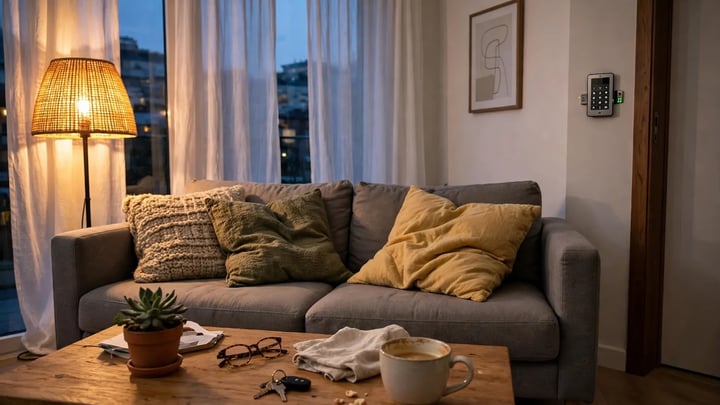
There is something quietly settling about two lamps glowing at the same low height on either side of a sofa. The light lands on book pages and coffee cups instead of on the ceiling, and the room feels gathered in rather than lit up. Pick shades in a warm fabric like linen, which softens the bulb, and keep both lamps at the same 2700K to 3000K warmth so the pair reads as one decision. If the sofa has only one end table, a single lamp still earns its place, and a floor lamp on the other side can balance it.
4. Create a Reading Corner With a Dedicated Floor Lamp

Every living room needs one chair that invites a long sit, and that chair needs its own light. A floor lamp placed just behind or beside the reading chair, about 12 to 18 inches (30 to 46 cm) to the side according to the Seus Lighting placement guide (2026), puts a pool of light exactly over the pages without lighting the whole room. An adjustable head or an arc arm helps, because it aims the light down at the book instead of across the room into the eyes of someone on the sofa.
Brightness matters more than style here. A lighting guide from Nordic Design Blog (2026) puts reading light at roughly 450 to 800 lumens at the page, which is far more than a decorative lamp gives. Check the bulb rating before buying, and pick a warm 2700K to 3000K bulb so the light feels like evening rather than an office desk. A dimmer on the floor lamp lets the same chair serve a bright afternoon read and a low, drowsy chapter before bed.
The pleasure of a reading corner is mostly sensory. A warm circle of light, the soft texture of the chair, a small table for a mug, and the rest of the room falling into a gentle dimness around it. That contrast is what makes the corner feel private even in a shared room. Keep the lamp shade opaque on the sides so the bulb never shows from the sofa, and the corner will glow without glaring.
5. Add Wall Sconces to Wash the Walls and Frame the Sofa

Wall sconces are the most underused light in the living room, probably because they feel like a commitment. They are worth it. A pair of sconces flanking the sofa or a fireplace washes the wall with soft light, which makes the room feel wider and taller without adding a single piece of furniture. Upward-facing shades bounce light off the ceiling for a gentle fill, while shaded sconces throw a focused pool that frames whatever sits below them.
Mounting height decides whether sconces look right. The Seus Lighting placement guide (2026) puts sconces 60 to 66 inches (152 to 168 cm) above the floor, and spaces multiples 6 to 8 ft (1.8 to 2.4 m) apart. Too low, and the fixture crowds the sofa back. Too high, and the light lands on the ceiling instead of the wall. On a sofa wall, center the pair on the seating, not on the room, so the glow frames the people sitting there.
Sconces also solve the problem of a room with no good place for lamps. A narrow sofa wall, a reading nook with no side table, or a hallway-like living room all benefit from light that lives on the wall instead of on furniture. Plug-in sconces with a cord cover work in rentals where hardwiring is off the table, and they still give the same warm wash. Where this usually goes wrong is mixing sconce styles at random across one wall, so keep the pair matched and the finish consistent with the other fixtures in the room.
6. Use Recessed Lights on a Dimmer for Even, Flexible Fill

Recessed lights, often called can lights, are the quiet workhorse of living room lighting. They disappear into the ceiling, spread even light across the floor, and never compete with the furniture for attention. That invisibility is their strength and their weakness. A ceiling full of recessed lights with no lamps looks like an office, so treat them as the background layer and let lamps do the warm work.
Spacing decides whether recessed lights look even or spotty. The Seus Lighting placement guide (2026) spaces them 4 to 6 ft (1.2 to 1.8 m) apart in living rooms with 8 to 9 ft (2.4 to 2.7 m) ceilings, and keeps them 2 to 3 ft (61 to 91 cm) from the walls so the light washes down instead of grazing the paint. Keep them off the direct line above the television, or the glare will fight the screen every movie night.
A dimmer is not optional here. Recessed lights at full brightness flatten a room, while the same lights at 30 percent give a soft base that lamps can build on. If the budget only stretches to one electrical upgrade, put dimmers on the recessed lights first. The cost of adding recessed lighting varies widely with wiring and ceiling access, and Angi (2026) puts the average near $360 per fixture, with a typical range of $100 to $480 per light, so get a local quote before planning a full grid.
7. Light the Art and Shelves With Picture Lights and Shelf Lighting

A living room with no accent light treats its walls like blank space, even when the art is good. A slim picture light over a framed print, or a small LED strip tucked under a shelf, pulls the eye to the things that make the room personal. The effect is outsized for the effort involved, because a lit object reads as chosen, while an unlit one reads as stored.
For art, a picture light mounted just above the frame and angled down gives an even wash without glare on the glass. For shelves, a warm LED strip under each shelf lights the books and objects below it, and the glow between shelves adds depth to the whole wall. A lighting guide from Nordic Design Blog (2026) suggests making an accent about three times brighter than the surrounding ambient light, so the object stands out without looking like a spotlight in a gallery.
This is also where a living room starts to feel like it belongs to someone. A shelf of well-loved books catching warm light, a framed print glowing softly above the sofa, a ceramic vase that finally gets noticed after years of sitting in shadow. None of it needs to be expensive, and none of it needs a gallery budget. One picture light and one shelf strip can change how the whole wall reads after dark, and both are easy to move if the art changes later.
8. Add a Low Glow Behind the TV for Better Movie Nights

Movie night is where living room lighting either helps or hurts. A bright screen in a pitch dark room makes the eyes work hard at the contrast, and a bright overhead light washes out the picture. The fix is a low, warm glow behind the television, often called bias lighting, usually from an LED strip stuck to the back of the set. The light spills onto the wall behind the screen, so the room is never fully dark and the screen never feels like a flashlight in a cave.
Keep the glow warm, around 2700K to 3000K, and dim enough that it reads as a halo rather than a second screen. A strip with a remote or a smart plug makes it easy to switch on only for films and switch off for conversation. The rest of the room can stay low at the same time, with one lamp on at its dimmest setting, so people can still find the snack bowl without a phone flashlight.
The sensory payoff is real. The room goes quiet, the wall behind the television holds a soft amber wash, and the picture feels bigger because the darkness around it is no longer total. It is the closest thing to a cinema at home without buying anything larger than a strip of lights, and it costs less than a single decent lamp.
9. Put Dimmers and Smart Scenes on Every Layer

A living room does at least three jobs in a day, and one light level cannot serve all of them. Bright light suits tidying up and finding a lost remote. Medium warm light suits conversation and drinks with friends. Low light suits a film or a slow evening. Dimmers let one room serve all three without anyone changing a bulb.
The simplest version is a dimmer switch on the ceiling fixture and dimmable bulbs in the lamps. The more useful version is a scene: one button or voice command that sets the ceiling to 30 percent, the lamps to warm and low, and the TV glow on. Smart bulbs and smart plugs make scenes possible without rewiring, which suits renters and anyone who wants to test a setup before committing to new switches.
Set the scenes around real evenings, not around the technology. A “hosting” scene keeps the room bright enough that guests can see each other across the sofa and find their glasses. A “reading” scene brings the corner lamp up and the ceiling down. A “film” scene drops everything except the TV glow. When the room shifts with one tap, people actually use the layers instead of leaving every light on full or sitting in the dark.
10. Keep Every Bulb Warm: 2700K to 3000K With High Color Rendering

Color temperature is the detail that separates a living room that feels warm from one that feels like a clinic. Bulbs rated 2700K to 3000K give the golden, relaxed light that suits evenings, conversation, and hosting. That range is the shared recommendation of lighting guides from UberCool (2026), InteriorDen (2026), and the Seus Lighting placement guide (2026). Bulbs above 4000K belong in a garage or a task bench, not over a sofa.
Color rendering matters too, and it is the number most shoppers skip. The color rendering index, or CRI, measures how true colors look under a bulb, on a scale up to 100. UberCool (2026) recommends CRI 90 or above for living areas, because a low CRI makes wood look grey, fabric look flat, and skin look tired. Two bulbs can share the same 2700K rating and still make the same room look different, and CRI is usually why.
The practical rule is simple. When a bulb burns out, replace it with a dimmable LED at 2700K to 3000K and CRI 90 or above, and do the same for every visible bulb in the room over time. Mixing a 2700K lamp with a 5000K ceiling bulb in one sightline looks wrong instantly, so check the box before buying. Warm light flatters almost everything in a living room, from oak floors to a linen sofa to the faces of the people sitting on it.
11. Light the Fireplace or Mantel as a Second Focal Point

Many living rooms have two focal points competing for attention: the television and the fireplace. Lighting decides which one wins in the evening. A mantel with its own light, even a small one, gives the fireplace a presence that a dark brick or stone wall never has on its own. A pair of small sconces flanking the mantel, a picture light over the art above it, or a low LED strip on the mantel shelf all do the job.
Keep the mantel light warmer and dimmer than the main seating light, so it reads as a glow rather than a display. The point is atmosphere, not brightness. On a winter evening, the combination of a lit mantel and low lamps makes the whole room feel gathered around the fire, even when the fire itself is not lit. The flicker of a real flame is hard to beat, but a warm, steady glow on the mantel comes close enough to change the mood of the room.
This focal point also earns its keep during the holidays, when the mantel carries garlands and stockings. When December arrives, our guide to “Christmas mantel decor ideas” shows how to dress the same focal point for the season. For the rest of the year, keep the mantel styling simple so the light, not the clutter, does the talking.
12. Keep Portable and Cordless Lamps Ready for Hosting

The last idea is the most flexible one, and the one most living rooms are missing. A small cordless lamp, the kind that charges on a base and runs for hours, can move wherever the evening goes. Put one on the sideboard when drinks are served there. Move it to the coffee table when guests crowd around a board game. Set two on the dining table when the party spills into the next room.
Cordless lamps solve the problem that fixed lighting cannot: people move, and light should follow them. They also rescue the corners that wired fixtures never reach, like a window seat, a bar cart, or a console behind the sofa. Pick warm 2700K models with a dimmer on the base, and keep them charged on a shelf near the living room so they are ready instead of forgotten in a drawer.
Hosting feels different when the light moves with the guests. A drink poured in a warm pool of light tastes better than one poured in the dark, and a conversation at a softly lit table lasts longer than one under a ceiling fixture. Fixed lighting builds the room, and portable light finishes the evening.
How Much Does Living Room Lighting Cost?
Lighting is one of the cheapest ways to change a living room, and the range is wide enough to suit almost any budget. Swapping bulbs and adding two table lamps can cost less than a single new cushion set, while a full recessed grid with new wiring is a real project. Start with the cheap layers first, live with them for a few weeks, and only then decide what needs an electrician.
For wired work, Angi (2026) reports an average light fixture installation cost near $600, with a typical range of $200 to $1,100, and chandelier installation commonly listed at $300 to $2,000 depending on size and wiring. Recessed lights average about $360 per fixture, with a typical range of $100 to $480 per light. All of these figures vary by region and material, and replacing an existing fixture costs less than adding a new one where no wiring exists. Get two or three local quotes before committing, and confirm whether the quote includes patching and paint, which is where surprise costs usually appear.
Conclusion
Living room lighting works best as a set of small, warm sources rather than one bright fixture. Start with the three layers, size the ceiling fixture to the room, put lamps where people actually sit, and keep every bulb warm and dimmable. Add sconces for the walls, a glow behind the television for films, and a portable lamp or two for the nights when guests fill the room. The room will not just look better. It will feel like the place where evenings happen.
If the seating arrangement still feels off, our guide to small living room layout ideas shows ten furniture arrangements that make the lamp and fixture placement in this article easier to plan.
Before buying a single lamp, check that the seating itself earns its place with our guide to modern living room furniture, which covers the essential pieces every living room needs.
Wall color changes how light behaves in a room, so our roundup of living room paint colors pairs well with the warm bulb advice above.
Lighting is one of the cheapest upgrades in our guide to how to decorate a living room on a budget, with 18 tips that keep the total spend low.
If you prefer fewer fixtures and cleaner lines, our minimalist living room decor ideas keep the look calm while the lighting does the warm work.
For a softer, pared-back style around the same seating area, our Japandi living room ideas show how low, warm light suits natural wood and linen.




Leave a Reply
You must be logged in to post a comment.