
A backyard does not need a five-figure budget to feel finished. Most tired yards suffer from the same few problems: no clear place to sit, ragged edges where lawn meets beds, bare soil, and darkness after sunset. Fix those four things and the whole yard reads differently, even if you change nothing else.
The ideas below are ordered by impact per dollar, not by difficulty. They start with work that costs nothing but an afternoon, then move to small purchases that pay off fast. Rough costs come from budget landscaping guides and are labeled as such, because prices vary by region and supplier. Check a local supplier before you buy.
Key Takeaways
- Edge the lawn and spread fresh mulch first. Together they cost little and make the yard look cared for faster than anything you can buy.
- Build one level place to sit before buying decor. A gravel pad with two chairs beats a yard full of ornaments with nowhere to sit.
- Buy small plants and divide the ones you already own. A 1-gallon perennial catches up to a 3-gallon plant within a growing season.
- Spend on light last in the budget but not in the plan. String lights are the cheapest way to make a seating area usable at night.
- Fix drainage before anything decorative. Water pooling near the house undoes every other improvement.
Before You Spend: Make a Plan
Walk the yard with a notepad before you spend a dollar. Write down what bothers you most and what you would actually use: seating, privacy, shade, greenery, lighting. Rank them. The most expensive mistake in a budget makeover is impulse buying, and a short list keeps the spending tied to the problems you actually have.
Set the budget in tiers. A basic refresh with edging, mulch, and solar lights runs about $100 in guide estimates. A gravel seating area with chairs and string lights lands closer to $500. Patios, hired labor, and new fences cost much more, and none of them belong in a first pass. Prices vary by region, so treat these figures as planning ranges, not quotes.
Fix water first. Downspouts that dump at the foundation create the soggy patch most budget yards are fighting. An extension pipe or splash blocks carrying water away from the house to a spot that drains solves more problems than any planting. Bury the pipe and you have a simple drain line. Do this before you build a seating pad or lay a path, because a pad built on a wet spot stays wet.
Measure the space you intend to use. A seating pad, a path, and a planting bed all need real dimensions, and guessing leads to buying twice. A tape measure and ten minutes prevent the most common budget error, which is buying furniture or materials that do not fit the spot.
15 Backyard Ideas on a Budget
1. Edge the Lawn and Beds
A sharp line where the lawn meets a bed or path makes the whole yard look cared for, even if you change nothing else. A flat spade works. A half-moon edger is faster. Cut straight down about 3 inches deep and pull the grass back toward the lawn.
This costs nothing if you already own a spade, and a budget guide puts the rough cost at free to $40 for an edger. It takes an afternoon for an average yard, and the result shows immediately. Re-cut the edge once or twice a season to keep it crisp. A common mistake is edging once and letting the grass creep back over the line by midsummer, which erases the whole effect.
2. Spread Fresh Mulch

Mulch covers bare soil, keeps weeds down, and holds moisture in the beds. It is the single fastest way to make planting beds look intentional. Spread it 2 to 3 inches deep and keep it off the trunks of trees and shrubs, as Clemson Extension recommends.
Bagged mulch runs $2 to $13 a bag and covers about 10 square feet at 2 inches deep, while bulk mulch costs $30 to $135 per cubic yard, according to a 2026 cost guide. A cubic yard covers about 160 square feet at 2 inches deep, so measure the beds before ordering. Wood chips can be free. Tree services often give away chips from local jobs, and many cities offer free mulch or compost to residents. Ask before you buy.
3. Build a Pea Gravel Seating Pad

A gravel pad gives you a level place to sit without concrete, and it costs a fraction of paving. It works best on flat, well-drained ground. Dig out the sod and soil 3 to 4 inches deep, lay landscape fabric to slow weeds, add firm edging on both sides so the gravel stays put, then a compacted crushed-stone base and the top stone.
A 10 by 12 foot pad at 2 inches deep needs about 20 cubic feet of gravel. Crushed angular stone packs firmer than round pea gravel, which shifts under chair legs, so choose crushed stone for the base and use pea gravel only as the top layer if you like its look. A budget guide puts a short gravel path at $75 to $300 for materials, and a seating pad lands in the same range depending on size. Two chairs and a side table finish it.
4. Lay a Stepping-Stone Path
A path stops the worn line through the lawn and connects the back door to the seating area. Big-box stores sell concrete stepping stones for $2 to $6 each. Set them in gravel or over compacted soil, spaced for a natural stride, and the whole path can cost under $50.
For a wider path, the same gravel method as the seating pad applies: dig out 3 to 4 inches, lay landscape fabric, edge both sides, and fill with gravel between the stones. The edging matters more than the stone. Without it, gravel migrates into the lawn within a season and the path loses its shape.
5. Divide the Plants You Already Own
Hostas, ornamental grasses, and many perennials can be dug up and divided. One plant becomes three or four, and the cost is zero. This is the cheapest way to fill a bare bed, and the divisions are already proven to grow in your soil and light.
Divide in spring or fall, when the plant is not in full growth. Dig up the clump, pull or cut it into pieces with roots attached to each piece, and replant at the same depth. Water the divisions well for the first few weeks. A common mistake is dividing in midsummer heat, when the pieces struggle to establish. If the plant is a single woody shrub or a tree, it does not divide, so stick to clumping perennials and grasses.
6. Buy Small Plants and Let Them Grow

A 1-gallon perennial at about $4 looks identical to a 3-gallon plant at about $18 after one growing season. The smaller plant establishes faster, because its roots are not circling a pot, and the savings add up across a whole bed.
Buy the smallest size a nursery sells for perennials, ornamental grasses, and groundcovers. Spend the savings on more plants rather than bigger ones, because a bed planted densely looks finished sooner than a bed with three large specimens spaced far apart. Trees and large shrubs are the exception. A small tree takes years to give shade, so buy the largest tree you can afford and go small on everything else.
7. Overseed the Thin Lawn Instead of Laying Sod
Thin turf often thickens with overseeding rather than new sod. Grass seed runs about $30 to $50 for a bag covering 5,000 square feet, versus $300 to $500 for sod to cover the same area. The seed route takes a season to show results, and the sod route takes a weekend, so the tradeoff is time against money.
Mow correctly while the lawn recovers. Clemson Extension advises removing no more than one-third of the grass height at a mowing, which also helps a recovering lawn. Water the seed lightly and often until it germinates, then shift to deeper, less frequent watering. If the lawn is mostly weeds or bare dirt, overseeding alone will not fix it, and reducing the turf area in favor of beds or a seating pad is the better move.
8. Hang String Lights

Nothing else at this price changes a seating area at night as much as string lights. A set runs $20 to $60, installs in an hour, and turns a plain pad or patio into the spot everyone gathers after dark.
Hang them in a gentle sag, not pulled tight, and anchor the ends to the house, a fence, or posts set in planters. Warm white bulbs suit a backyard better than cool white, which reads harsh against wood and foliage. A common mistake is hanging a single short strand that leaves half the seating area dark. Measure the span first, buy a strand with length to spare, and keep the bulbs above head height so nobody walks into them.
9. Add Solar Path Lights
Solar lights need no wiring and switch on by themselves at dusk, which makes them the easiest lighting to install. A set of four path lights runs about $15 to $20, and a full set of string lights, path lights, a lantern, and a spotlight can come in under $80.
Use them to mark paths and bed edges, not to light a whole patio. They are dimmer than wired lights and fade after cloudy days, so they work as markers and accents. Place them where they get direct sun during the day, or they will barely glow at night. A common mistake is lining every edge with them, which looks like a runway. Space them unevenly, about 6 to 8 feet apart, and let some stretches stay dark.
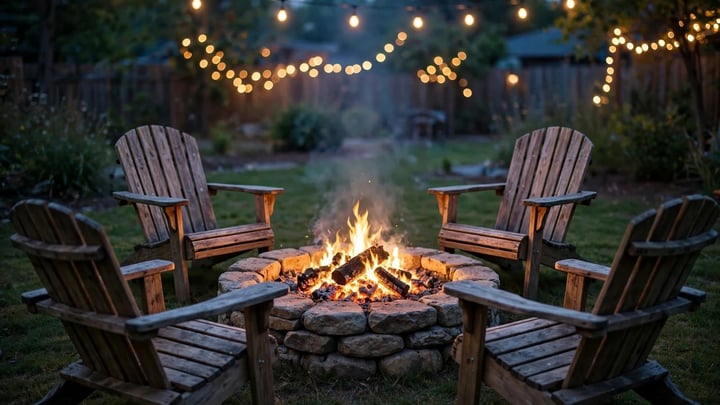
10. Build a Simple Block Fire Pit

A backyard fire pit creates a gathering place in one afternoon. The simple version uses stacked blocks and gravel, requires no mortar, and the materials are readily available at a nearby hardware store. Set a steel ring on gravel, stack the blocks around it, and leave a gap at the base for airflow.
Check local burn rules first, because some towns restrict open burning or require a setback from fences and structures. Gas fire features are licensed work, so do not plumb gas yourself. Keep the pit away from overhanging branches and low eaves, and keep a hose or a bucket of sand nearby. A wood fire pit on gravel is a different project from a gas fire table, and the budget version is the wood one.
11. Paint or Stain the Fence
A tired fence makes the whole yard look tired, and a fresh coat changes the boundary more than any planting. Paint or stain is far cheaper than replacing boards, and the work is straightforward: clean the fence, let it dry, and apply two thin coats rather than one thick one.
Choose a color that recedes. Dark greens, charcoal, and warm browns make planting stand out and make the fence read as a backdrop instead of a feature. White and pale colors show dirt fast and glare in summer sun. If the fence is badly rotted or leaning, paint will not save it, and the money is better spent on a section of replacement boards.
12. Build a Cinder-Block Bench
Two cinder blocks and a 2 by 6 board make a bench that costs under $20. Stack two blocks on each end, lay the board across the top, and add an outdoor cushion. It is sturdy, it drains, and it can be taken apart and moved.
Paint the blocks to match the fence or the house trim, and the bench stops looking like construction material. Cap the blocks with flat pavers if the open cores bother you, or plant trailing herbs in the cores for a living detail. A common mistake is using an untreated board that warps after one wet season, so choose pressure-treated lumber or a hardwood board and seal the ends.
13. Refinish Secondhand Furniture
Look for pieces at garage sales, thrift stores, and on local marketplaces. A budget of $50 to $100 can often find a full set, and a can of spray paint at about $8 can turn rusty old chairs into statement pieces. Refinish and paint rather than replacing, and the yard gets furniture with character for a fraction of retail.
Check the frame before you buy. Solid wood and metal frames are worth refinishing, while wobbly plastic and rusted-through joints are not. Sand loose rust and flaking paint, prime bare metal, and use exterior paint rated for outdoor use. A common mistake is painting over rust without prep, which peels within a season and wastes the effort.
14. Plant a Privacy Screen from Divisions and Cuttings
A new fence is expensive, and a living screen costs far less. Join a local plant swap group and trade plants with other gardeners in your area, or take divisions from your own beds and cuttings from a neighbor’s shrubs. Tall ornamental grasses, bamboo in containers, and fast-growing shrubs fill a sightline within a season or two.
Plant in a staggered row rather than a straight line, so the screen looks like a planting bed instead of a wall. Mix heights and textures, and leave gaps for air and light, because a solid wall of one species looks flat and suffers when one plant dies. Containers work for renters, since bamboo and tall grasses grow well in large pots and move with you.
15. Set Up a Backyard Movie Night
An all-weather TV can cost hundreds or thousands of dollars, but a projector and a screen cost far less and store indoors when not in use. Hang a white sheet or a portable screen between two posts, set the projector on a small table, and add a Bluetooth speaker.
The seating you already built does the rest. Two chairs, a cushion, and the string lights from idea 8 make a movie night without buying anything new. Keep the screen out of the wind path, and run the projector from an outdoor-rated extension cord with a covered connection. A common mistake is aiming the projector across the seating area, so people walk through the beam. Put the projector behind the seats and the screen in front.
What to Do First: The Order That Saves Money
Start with drainage and low spots, because water undoes everything built on top of it. Then build one level place to sit, since seating is what turns a yard into a room. Next come the edges and mulch, which make the yard look cared for for very little money. Plants come after the structure, and lights and extras go last, once you know where people actually sit in the evening.
This order also spreads the spending. The first three steps can cost under $200 combined, and each one makes the yard visibly better on its own. If the budget runs out after step three, the yard still looks finished. A yard with a new fire pit and no seating, no edges, and no light does not.
Common Mistakes
A common mistake is buying furniture before measuring the space. A set that looked right in the store overwhelms a small pad, and returning it costs more time than measuring would have. Measure first, then shop.
Another is planting sun lovers in shade and shade lovers in sun. The plant tag tells the truth, and a plant in the wrong light never thrives no matter how much water it gets. Match the plant to the spot, not to the picture on the tag.
Skipping edging under gravel is a third. Gravel without edging migrates into the lawn within a season, and the pad loses its shape. Edging is cheap and it is the difference between a pad and a pile.
Buying big plants when small ones catch up in a season wastes money that could buy more plants. And lighting the whole yard with solar lights wastes effort, since solar lights are markers, not floodlights. Use them where they mark a path and let the dark stay dark elsewhere.
FAQ
What is the cheapest way to make a backyard look better?
Edge the lawn and beds, then spread fresh mulch. Edging costs nothing with a spade, and bagged mulch runs $2 to $13 a bag. Those two jobs make a yard look cared for faster than anything you can buy.
How much does a budget backyard makeover cost?
A basic DIY refresh with edging, mulch, and solar lights can cost about $100. A gravel seating area with chairs and string lights is closer to $500. Patios and hired labor cost much more. These are rough guide figures, and prices vary by region.
Can I do all of this in one weekend?
Edging, mulch, lights, and a gravel pad fit in a weekend. A fire pit and fence painting each take a day of their own. Planting divisions and overseeding are quick to do but take a season to show results.
Do I need a permit for a fire pit or a gravel patio?
Rules vary by town. Check local burn rules before building a fire pit, and check setback rules if the pit sits near a fence or structure. A gravel pad at grade rarely needs a permit, but a raised structure or a gas line does.
Conclusion
A backyard transformation on a budget is mostly a sequence, not a shopping list. Edge and mulch first, build one level place to sit, divide and plant small, then add light and fire. Each step costs little on its own, and each one makes the yard better even if the next step waits until next month. Start with the work that costs nothing, and let the yard tell you what it needs next.



Leave a Reply
You must be logged in to post a comment.