
A small backyard is not a failed backyard. It is a yard with a short list of jobs it can do well, and the work is choosing that list before buying anything. Most disappointing small yards fail the same way: a table arrives, then a fire pit, then a few planters, and each piece picks its own spot. Nothing is wrong with any single piece. The pieces just never agreed on a plan.
The fix is unglamorous and it works. Measure the yard, watch the sun, pick two or three jobs for the space, and give each one a defined place. The numbers here are planning ranges from common layout guides, not building code, and the checklist at the end says which ones still need a local check.
Start With a Plan, Not a Purchase
Measure the Real Yard
Pace the yard with a tape measure, not your eye. A yard that feels like 20 by 30 feet often measures closer to 17 by 26 once fence posts, the air conditioning unit, the gate swing, and the step down from the back door are counted. Write down the length and width, the door and gate positions, and anything fixed in place: the AC unit, a hose bib, a downspout, a shed, a tree that stays.
Then watch the sun. A dining spot that bakes at 6 p.m. in July will sit empty all summer, while a lounge chair in the one patch of afternoon shade will get used every day. Spend one weekend noting which corners get sun at breakfast, lunch, and dinner. That patch of shade feels different too. The air stays cooler there, the seat does not sting bare legs, and an evening meal stretches out because nobody is squinting into low sun or hunting for a hat.
Pick Two or Three Jobs, Then Stop
A small yard can hold about three purposes. Common combinations that work: sit and eat, sit and garden, sit and play. Trying to add a fourth, a full outdoor kitchen plus a fire circle plus a play set plus a vegetable garden, turns the yard into a storage lot with chairs in it.
Write the list in priority order. If evening meals matter most, dining gets the best spot. If quiet mornings matter most, a two-seat nook near the door wins and the grill takes a corner. If a piece does not serve one of the three jobs, it does not come home.
Think about how each job should feel at the end of a long day. A dining spot should feel easy and unhurried, with room to linger after the plates are cleared. A quiet nook should feel sheltered, somewhere you can hear birds and feel the breeze without traffic noise or a hard glare in your eyes. When a yard serves its jobs well, stepping outside becomes a habit. When it does not, the back door stays shut, even on a fine evening.
Renters get a useful version of the same rule. Everything should be movable, freestanding, or hung from removable hooks: pavers set on sand, gravel in a contained bed, container planting, and a folding bistro set all leave with you. A poured pad and a built-in bench do not.
Check the Rules Before Building
Small yards sit close to neighbors, fences, and property lines, so the rules matter more here than on a big lot. Check the local setback for structures and fire features, any homeowners association rule on fences and sheds, and the location of buried utilities before digging. In the United States, calling 811 before digging is the standard step for locating underground lines.
The Three-Zone Layout That Works in Most Small Yards
One Seating Zone, One Path, One Planting Band

The most reliable layout for a small yard has three zones and nothing else competing for floor space. First, a seating zone: one pad where people sit. Second, a path: one line from the back door to that pad. Third, a planting band: one continuous strip along the longest fence that holds the plants. When every object belongs to one of those three, the yard reads as designed. When objects drift into the middle, it reads as crowded.
Place the seating zone first, because it is the largest thing the yard must hold. The far corner, diagonally opposite the back door, is often the best spot. The walk to it makes the yard feel longer, and two fences give it a back on two sides. A seating pad for a two-seat sofa, two chairs, and a small table needs roughly 10 by 10 feet once legroom and a route out are counted. A pair of armchairs and a side table fits in about 7 by 7 feet. Those are planning ranges from layout guides, and they are worth testing with painter’s tape on the ground before ordering furniture.
The path runs from the door to the pad in a straight line or a single diagonal. Curves look charming in photos and cost square footage a small yard cannot spare. Keep the path about 36 inches wide so two people can pass and a tray can be carried without turning sideways. In a very tight yard, a short one-person route of about 30 inches can work, but only where nobody needs to pass behind a seated guest.
The planting band runs along the longest fence, about 24 to 36 inches deep. At 24 inches it holds two layers, a climber on the fence and a row of plants in front. At 36 inches it holds three, a climber, a mid-height shrub, and a low front layer. Deeper than that, the band starts taking space the seating zone needs.
Three Yard Sizes, Three Versions of the Same Plan
The largest yard that still behaves like a small one measures around 20 by 30 feet, about 600 square feet. A 12 by 12 foot seating corner in the far end, a 36 inch path, and a 36 inch planting band along the long fence still leave a generous open middle. Keep that middle open. It is the breathing room that keeps 600 square feet from reading as full, and it can hold a portable fire bowl later without moving any zone.
A yard around 15 by 20 feet, about 300 square feet, is the most common small suburban yard, and the size where the plan matters most. Put the seating pad across the far end, run the path down one fence, and put the planting band along the other. The open square left in the middle stays one material, gravel or lawn, with nothing standing in it. A dining set and a lounge set do not both fit here. The pad takes one, and the other becomes a pair of folding chairs hung on the fence.
At around 10 by 12 feet, about 120 square feet, the yard is a room and should be planned like one. One wall of seating, one route, one wall of planting. A built-in bench across the far end, a 30 inch route from the door, and a 24 inch planting band along one long fence leave a small patch of ground in a single material. One tree is too many here. The ceiling is string lights or a shade sail, and every object has a wall behind it.
Choose One Focal Point and Let It Lead
A small yard needs one thing the eye lands on first. Without it, everything competes and nothing feels finished. With it, the rest of the yard becomes supporting cast, which is exactly what a small space needs.
The focal point can be the seating group itself, a small tree, a water bowl, or a fire bowl. Pick the one that matches the yard’s top job. A dining yard leads with the table. A relaxing yard leads with the lounge chairs and a tree behind them. Where this usually goes wrong is installing two or three features that each demand attention in 200 square feet. Each one shrinks the others.
Scale the focal point to the yard, not to the catalog photo. A fire bowl about 18 inches across suits a small gravel circle. A tree that matures to 20 to 30 feet tall gives privacy and seasonal color without overwhelming the space, and small trees with fall color such as Japanese maple, dogwood, and flowering crabapple are the usual recommendations in garden guides.
Seating That Fits the Zone, Not the Yard You Wish You Had
Scale Down the Furniture, Not the Comfort

Oversized outdoor sectionals and eight-person dining tables are the fastest way to kill a small backyard. Furniture needs to fit the zone it belongs to, and the zone is smaller than the yard. Armless chairs save several inches each. Backless stools tuck completely under a table when not in use. Low-profile lounge chairs beat a full L-shaped sofa on a compact pad, and they leave sightlines open so the yard feels larger.
Test the fit before buying. Tape the furniture footprint on the ground, add about 18 inches between a sofa and its coffee table, and about 30 inches behind a dining chair for someone to stand up. Walk the path with a tray. If you have to shuffle sideways, the set is too big for the pad, whatever the product page says.
The Built-In Bench Gives Floor Back

A built-in bench along a fence is the single best seating move in a small yard, because it uses the fence as its backrest. A 60 inch run of bench seating takes about 18 inches of depth instead of the roughly 36 inches a freestanding sofa needs. Seat height lands around 18 inches finished, with seat depth around 18 inches against a wall. A back board tilted 10 to 15 degrees makes a real difference, because a plumb wall behind the shoulders is the reason built-in benches go unused.
Run the bench in an L around a corner and it seats six on two legs of about 84 and 60 inches. Add a hinged top and the bench becomes storage for cushions and garden tools. Keep a small toe kick so heels tuck under. One continuous cap along the top doubles as a place to set drinks. A bench fixed to a shared fence needs the neighbor’s agreement, and a freestanding version avoids that conversation entirely.
Sit on a bench for a minute before you decide the details. A bench that feels right has a seat that stays warm in evening sun, a back that lets your shoulders drop, and a surface that does not feel cold and hard against bare arms. Get that right and the bench becomes where people drift after dinner, mugs in hand.
Fold, Stack, and Roll the Rest
Every other seat in a small yard should fold, stack, nest, or roll. Folding chairs hang on fence hooks when guests leave. A nesting side table slides under the main table. A bar cart rolls out for drinks and rolls into the garage after, and doubles as a garden cart in planting season. The test is simple: can one person clear the pad in under two minutes? If not, the furniture owns the yard instead of serving it.
Dining Outside Without Giving Up the Whole Yard
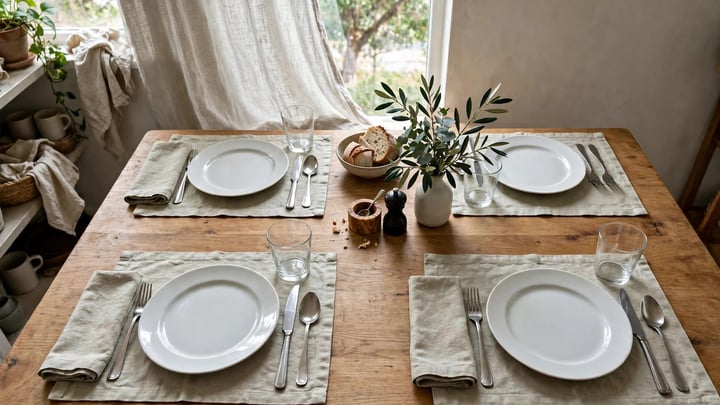
A dining zone for four needs about 8 feet of depth: roughly 30 inches of chair on each side plus a 36 inch table. That is the whole depth of some small yards, which is why dining and lounging rarely share a small pad as equals. Choose one as the main event and let the other borrow the space.
A 30 inch round bistro table with two chairs is the honest answer for most small yards. It seats two for coffee and dinner, leaves room to walk around it, and costs little floor. If the yard must host six sometimes, an extendable or drop-leaf table earns its keep, expanding for the evening and shrinking for the other six days.
Evening meals outside have a smell and a pace of their own. Warm food, cut grass, and cooling air mix in a way that makes a simple dinner feel like a small occasion. That feeling fades fast if chairs scrape and wobble on uneven pavers, or if the table sits in a drafty corner where plates cool before anyone finishes. A sheltered spot and a steady surface will keep people at the table long after the food is gone.
Keep the grill close to the back door and the dining spot, in an L-shaped corner with a small side table for prep. Staging cooking and eating together keeps traffic in one area instead of threading it through the lounge zone. A compact grill on a rolling cart beats a built-in grill station in a yard under 300 square feet, because the cart moves aside when the space needs to be a lounge again.
Go Vertical: Walls and Fences Are Free Square Footage
When growing out is not an option, grow up. Fences, house walls, and trellises hold plants, lights, shelves, and storage that would otherwise eat floor space. Vertical planting boxes fixed to a fence grow herbs, flowers, and seasonal plants without taking a single square foot of ground. Hanging planters do the same from a beam or a bracket.
A trellis does double work. It holds climbing plants and it screens a view at the same time, which matters when the neighbor’s second story looks straight into the yard. A narrow trellis covered with a climber takes about a foot of depth and gives back a green wall several feet tall. A slatted cedar screen about 6 feet tall behind a lounge chair creates a private corner without building a new fence.
A green wall changes more than the view. It softens sound, so the yard feels quieter, and it gives off a fresh, leafy scent after rain or watering. Brushing past herbs on the way to the door releases their scent too, a small pleasure on the walk to the seating area.
Keep vertical planting practical. Containers on a wall dry out faster than beds in the ground, so they need more frequent watering. Heavy planters need proper fixings into studs or masonry, not just a nail in a fence board. Succulents suit hot, dry, sunny walls with little care. Leafy herbs and vegetables want the sunniest wall and regular water, and they belong where the cook can reach them from the door.
Plant Tall and Narrow, Keep the Middle Open
Choose Plants by Shape, Not Just by Color
The planting mistake in small yards is choosing plants by flower color and ignoring mature shape. A shrub that spreads 6 feet wide will swallow a planting band in two seasons. Plants with a naturally narrow, upright habit do the work instead. Columnar evergreens, clumping bamboo in containers, and slim ornamental grasses give height and screening without width. The University of Florida Extension guidance often cited in garden writing points to the same idea: tall but narrow plants that hold their form make effective screens in tight spaces.
Repeat a small number of plants instead of collecting one of everything. One shrub every 4 feet with the same perennial repeated every 18 inches in front of it reads as designed. Eighteen different plants in a 20 foot band reads as a nursery bench. Repetition also makes care simpler, because one watering and pruning routine covers the whole band.
Push Beds to the Edges

Push every bed to the perimeter and keep the center open. A bed in the middle of a small yard divides it into two unusable slivers. A bed along the fence leaves the middle free for seating, play, and walking. The same rule applies to containers. Group pots in threes at the edge of the pad or along the fence, not scattered across the open ground. A cluster of three pots in graduated heights looks intentional. Seven single pots spread around the yard look like clutter waiting for a home.
A 4 by 4 foot raised bed is the practical limit for a small-yard vegetable patch, and square-foot spacing keeps it productive: one large plant per square foot, four medium plants, or sixteen small plants such as carrots. That layout comes from square-foot gardening guides and it works because the bed is small enough to reach across from every side. Put the bed where it gets the most sun, near the door, and skip the second bed until the first one earns it.
Privacy Without Building a Fortress
A small yard feels exposed because every fence line is close. The answer is rarely a taller fence. Tall solid fences make a small yard feel like a courtyard with a lid, and many neighborhoods cap fence height anyway. Break up sightlines instead.
Layer the screening. A low hedge or a row of planters at eye level from a seated position blocks the view that matters, which is the view from the chairs, not the view from standing at the fence. A lattice panel or trellis above a fence adds height without solid mass, and a climber softens it further. Outdoor curtains or bamboo shades on a pergola beam give privacy on one side and roll away when the breeze matters more.
Potted trees are the renter-friendly version. A slim tree in a large container screens a second-story window and moves when the lease ends. Check the mature height before buying, and keep the container large enough that the tree does not topple in wind.
Ground Surfaces That Define Zones
Let Materials Draw the Lines
In a small yard, a change of ground material defines a zone better than a wall does. A composite deck platform under the lounge chairs, pea gravel in a circle for a fire bowl, and concrete pavers under a dining set each say what happens there, without a single fence or railing. Keep the palette to two or three materials. More than that, and the yard looks like a sample board.
Pavers and concrete slabs are easy to clean and hold furniture steady, but they cost more to install and they hold heat in summer. Gravel and mulch are cheaper and cooler underfoot, and they drain well, but chairs sink into soft gravel and mulch needs topping up. A firm middle ground is decomposed granite or compacted gravel with stepping stones set flush, which reads as a path and drains without puddling.
Think about bare feet and tired legs at the end of the day. Hot pavers can sting on a July afternoon, while cool gravel feels pleasant underfoot but can dig into soft soles. A surface that feels good to walk on in socks or bare feet gets used more, simple as that. People linger where the ground feels kind, and they hurry across ground that does not.
Mind Water Before It Minds You
Small yards flood faster than big ones because there is less ground to absorb rain. Grade the ground so water runs away from the house, not toward it, and keep a gap between soil or mulch and the siding. A patio should fall slightly away from the house, about 1 to 2 percent in common patio guides, which is roughly a quarter inch per foot. That is a planning figure to confirm with the installer, not a measurement to set by eye.
Downspouts deserve a thought before furniture does. A downspout that empties onto the seating pad will ruin more evenings than a bad chair. Extend it to the planting band or a gravel bed where the water can soak away.
Light for Evenings, Shade for Afternoons
Light the Zones, Not the Whole Yard

A small yard needs less light than people expect. One warm layer over the seating zone, one along the path, and one accent on the focal point is enough. Warm light around 2700 to 3000K suits evening sitting and matches the warm range used indoors. Cool white light makes a small yard look like a parking area, so skip it.
String lights are the workhorse. Hung at about 8 feet or from a sail, they give a ceiling to the seating zone and make it feel like a room. Solar stake lights set along the front edge of the planting band every 6 to 8 feet mark the edge without glare. A small sconce or two above a built-in bench lights the seat without shining in anyone’s eyes. Keep fixtures low and warm, and put the brightest light near the door, where people carry food and find their footing.
Shade That Does Not Eat the Yard
Afternoon sun decides whether a small yard gets used in summer. A shade sail is the best answer for most small yards: it covers the seating zone, needs only a few anchor points, and comes down in winter. A 10 by 10 foot sail suits a compact pad, and it should sit high enough to walk under without ducking, with one corner lower so rain runs off.
An umbrella works when the seating group is small and fixed in one place. A cantilever umbrella shades a table without a pole in the middle of it, which matters when every inch counts. A pergola gives permanent structure and a frame for curtains and climbers, but it also takes the most space and budget, and it needs a footing. Skip the pergola in a yard under 150 square feet unless shade is the yard’s top job.
Storage That Disappears
Storage is where small yards go to die. Cushions, tools, toys, and hose reels left in the open read as clutter within a week. Every item needs a home that closes.
A bench with a hinged top is the best storage in a small yard because it is already furniture. Cushions live inside it, tools live under the seat, and the lid keeps rain out. A slim deck box against the fence holds the same things where no bench exists, but it needs to stay narrow, about 18 to 20 inches deep, or it becomes a wall of plastic. Wall-mounted shelves near the door hold small pots and tools without touching the ground.
Fire, Water, and Play: What Fits and What Does Not
A fire feature earns its place in a small yard only when the setbacks allow it. Fire guidance commonly cited in the United States puts a portable fire feature about 10 feet from anything that can burn, and wood-burning fires are commonly held to 15 to 25 feet from a structure under many local codes. Those numbers are reported guidance, not a permit, and the local fire code is the rule that counts. In a 20 by 30 foot yard, a 10 foot ring from the house, the fence, and the shed may leave one workable spot. In a 15 by 20 foot yard it usually leaves one tight spot. In a 10 by 12 foot yard it leaves none, and the honest answer there is a tabletop gas bowl or no fire at all.
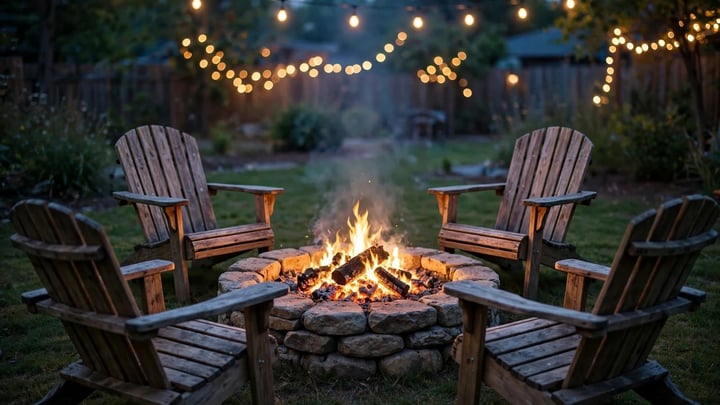
Build the fire corner on gravel, never on turf, with seats about 36 to 42 inches from the bowl’s edge. A bowl about 18 inches across suits a gravel circle 10 to 12 feet across. A fire pit table does double duty as a table and a heat source, which is the only fire feature that makes sense when floor space is the scarcest resource.
A fire bowl also changes how an evening sounds and feels. The low crackle, the warmth on your face, and the soft light on the people around the circle make conversation slow down. That warmth is what keeps people outside after the sun drops and the air turns cool, long after a bare patio would have sent everyone indoors.
Water follows the same logic. A small bowl, a wall fountain, or a bubbling pot fits a small yard. A pond does not, because it takes floor space, needs maintenance, and becomes a safety question with small children. If kids use the yard, the play zone gets one defined spot with soft ground under it, away from the dining area, and the toys live in one bin at its edge. A play set that fills the yard is a sign the yard has one job, play, and the adults have agreed to that.
What does not fit, in most small yards: a full outdoor kitchen with a built-in grill, fridge, and counter run; an inground pool; a hot tub plus a dining set plus a lounge set; and a shed large enough to hold a lawn tractor for a lawn the size of a rug. Each of those belongs to a bigger yard or to a yard with one single purpose. Saying no to one of them is what makes the other three jobs work.
Make a Small Yard Feel Bigger
The eye decides how big a yard feels, and a few design choices push it in the right direction. Repeat one material and one or two colors through the yard. A single paver color, one wood tone, and cushions in two close shades read as calm. Five materials and six colors read as busy, and busy reads as small.
Lead the eye to the far end. The focal point belongs at the back of the yard, not beside the door, so the gaze travels the full length. A path that runs diagonally to a far corner makes the yard feel longer than a path that stops halfway. A mirror on a fence can bounce light into a shaded corner, but it needs care: place it where it reflects planting and sky, not the neighbor’s window, and fix it firmly so wind does not take it down.
Keep the middle open and the edges planted. A lawn or gravel field with nothing standing in it feels larger than the same area filled with small objects. Low planting at the front edge of the band, about 12 to 18 inches tall, softens the line where soil meets path without blocking the view across the yard. Tall planting belongs at the back and sides, where it frames the space instead of dividing it.
Mistakes That Shrink a Small Yard
A common mistake is buying furniture before measuring the pad. Tape the footprint first, every time.
Where planting usually goes wrong is buying one of everything. Repeat a few plants that suit the sun and soil, and let repetition do the designing.
The trap here is splitting the yard into too many zones. Four or five tiny zones feel fragmented, while three zones with clear edges feel finished.
A common mistake is putting the focal point by the door, so the eye stops there and the rest of the yard becomes background. Move the thing worth looking at to the far end.
Skip the drainage and sun check until after the patio is poured, and the yard will punish that order for years. Water and shade are site facts, not decor choices. Map them first, and the furniture decisions get easy.
Where to Start This Weekend
Start with the tape measure and the sun watch, not the store. Mark the seating pad, the path, and the planting band with string or painter’s tape, then live with the lines for a week. Walk them with a tray. Sit in the marked corner at dinner time. Move the tape if the sun says so.
Then do one zone at a time: the seating pad and its surface, the planting band, the path, then light and shade once the sun proves where they fall. The fire bowl comes last, once the setbacks are checked.
A small backyard rewards restraint more than spending. Three zones, one focal point, furniture that fits its pad, planting pushed to the edges, and nothing in the middle that does not earn its floor. That is the whole method, and it works at 120 square feet just as it works at 600.
Frequently Asked Questions
Can a small backyard fit both dining and lounging?
It can fit one of them well and the other as a borrowed use. Give the pad to the activity that happens most, then let the other borrow it with folding chairs or a bistro set that moves aside. Two full sets in a yard under 300 square feet leave no room to walk between them.
If the budget is tight, our backyard ideas on a budget shows which changes give the most impact for the least spending.
Want more planting ideas once the layout is set? Our small garden ideas offers twenty planting-led ways to fill a compact yard.
How much space does a fire pit need in a small yard?
The setback decides before taste does. Commonly cited guidance puts a portable fire feature about 10 feet from anything that can burn, with wood fires often held further under local codes. Check the local code first, then see whether any spot in the yard still meets it. In many yards under 150 square feet, the answer is a tabletop gas bowl or no fire at all.
Conclusion
A small backyard asks for decisions, not square footage. Measure it honestly, give it three jobs, and draw three zones that serve them. Choose one focal point at the far end, size the furniture to its pad, push planting to the edges and up the walls, and keep the middle open. Light it warm, shade the seating, and store everything behind a lid. The yard will not get bigger. It will feel bigger, because every inch will have a reason to be there.
Building the seating area out? See our guide to patio design ideas for turning a small pad into a real outdoor room.
Thinking about cooking outside as well? Read our outdoor kitchen ideas before giving a grill station floor space a small yard cannot spare.
For the planting band along the fence, our modern garden design ideas covers clean lines and repeated planting that suit a narrow strip.



Leave a Reply
You must be logged in to post a comment.